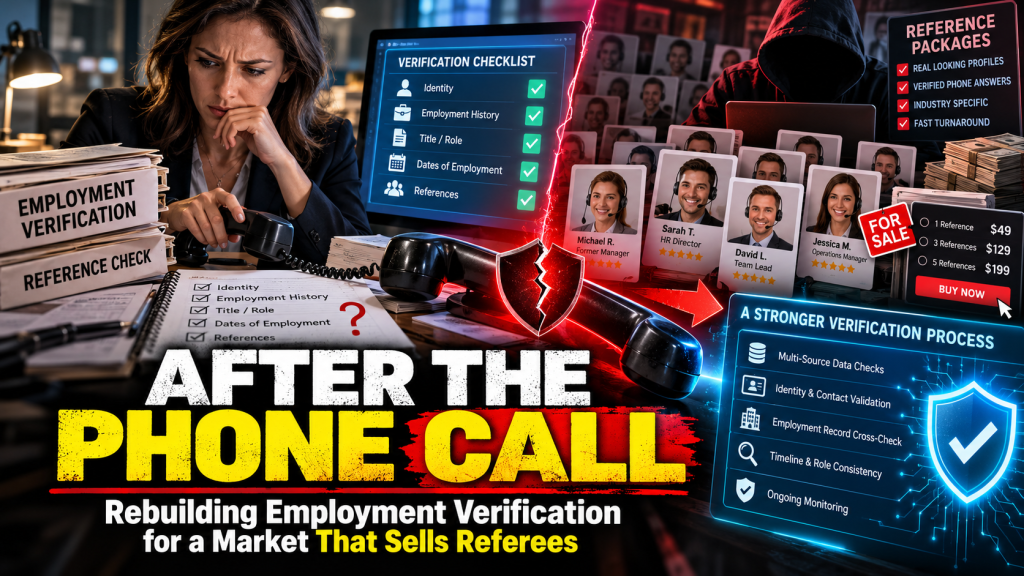
If the reference call has broken down as a way of verifying employment history, and it has, the response is not to make the call louder or more often. It is to change what you verify against. The favour-based model asks a former employer to vouch for a candidate. The record-based model checks the candidate’s claims against data the employer already created while the person worked there and reported to a neutral third party. One depends on cooperation and trust. The other depends on facts that already exist.
This is the operational shift, and it is more achievable than most HR teams assume, because the authoritative records already exist in most major markets. Here is how to build verification around them.
Start From the Record, Not the Referee
The governing principle is simple. Whenever possible, verify employment against a contemporaneous, third-party record rather than against anyone’s present-day say-so.
The reason this works is that it removes the candidate’s version from the equation entirely. If someone claims they worked at a company from 2020 to 2023, but the payroll or statutory record shows contributions stopping in 2021, the discrepancy surfaces immediately, regardless of what the CV says and regardless of whether anyone answers the phone. The record is not generous, it is not coachable, and it was created before there was any incentive to lie, because at the time it was just routine administration. That is exactly what makes it trustworthy now.
Use the Authoritative Source for Each Market
The specific source varies by country, but the pattern is consistent: find the place where employment was recorded contemporaneously and reported to a third party.
In the United States, the leading example is The Work Number, operated by Equifax Workforce Solutions since 1995. Employers and payroll processors feed employment and income data into it, typically through automated weekly payroll feeds, and credentialed verifiers query it in real time. It holds hundreds of millions of employee records from millions of employers and returns instant verification of employment and income, under FCRA permissible-purpose rules.
In India, the equivalent is UAN and EPFO. Every salaried employee whose employer contributes to the Provident Fund is assigned a twelve-digit Universal Account Number, which links to records held by the Employees’ Provident Fund Organisation, a statutory government body. With the candidate’s consent, those records yield an instant, government-sourced employment timeline: employer names and establishment codes, exact dates of joining and leaving, and tenure derived from actual monthly contributions. Verification that takes a phone-based check five to fifteen days resolves in seconds to minutes, with accuracy approaching 100 percent, because it reflects what the government recorded, not what the candidate asserted.
The lesson generalises. Wherever you hire, the strongest first question is not “who can I call” but “where was this employment contemporaneously recorded by a third party,” and verify there.
Make Authoritative Data the First Layer, Not the Only Layer
The most efficient model is a hybrid one, and getting the sequence right is what delivers both speed and certainty.
Run the authoritative-data check first, on everyone. In the Indian context, EPFO-based verification resolves something like 60 to 70 percent of employment checks instantly and conclusively, leaving only the remainder to require slower human outreach. That single change drops overall turnaround for the majority of candidates from a week or more to under a day, while making the result far harder to fake. Authoritative data is fast, cheap, and fraud-resistant, which is exactly the profile you want for the first pass across the whole pipeline.
What it is not is complete, and pretending otherwise is its own failure mode.
Know What the Record Doesn’t Say
Good verification is honest about its limits, and authoritative-data sources have real ones that you must design around rather than ignore.
Payroll and statutory records confirm employer and tenure. They generally do not confirm designation. EPFO records show that someone worked at a company and for how long, but not whether they were a “Senior Engineering Manager” or a junior developer. They do not record the reason for leaving, so a voluntary resignation and a termination look identical. They say nothing about performance. And they have coverage gaps: the informal and unorganised sector, very small employers that do not contribute, freelance and self-employment, and overseas stints will simply not appear, and their absence is not in itself evidence of fraud. The Work Number has its own analogous gaps for smaller employers that do not feed payroll data into it.
An organisation that treats a blank authoritative-data result as proof of dishonesty will wrongly reject honest candidates. An organisation that treats a positive result as the whole story will miss the things the record cannot see. Both errors come from forgetting what the source is actually telling you.
Use Targeted Human Verification for the Gaps
This is where the reference call earns its place again, in a smaller and far sharper role. Human verification is no longer the first and only line. It is the targeted tool for the specific things records cannot confirm.
Reserve direct employer outreach for the cases that genuinely need it: confirming designation on senior or client-facing hires where title carries weight, validating overseas employment outside any domestic database, and filling informal-sector gaps. And when you do make that call, treat the identity of the referee as something to verify, not assume. Confirm the person through the company’s own channels rather than a number the candidate supplied, insist on a real-time conversation rather than email-only responses, and be alert that the voice on the line can now be synthetic. The human check, used this way, complements the record instead of being asked to do the record’s job badly.
Catch Dual Employment in the Same Data
A significant bonus of the record-based approach is that it surfaces a fraud the phone call almost never catches: dual employment, or moonlighting.
When authoritative data shows contributions arriving from two different employers in the same months, that is concurrent employment sitting in plain sight, with no inference and no detective work required. In India this became a prominent concern in the tech sector after 2022, and EPFO data turned out to be one of the most reliable ways to detect it, because the contribution record does not lie and does not wait for anyone to respond. Build this check into the standard verification rather than treating it as a separate exercise. The data you are already pulling to confirm tenure also answers the moonlighting question for free.
Get Consent and Stay Compliant
Accessing authoritative records is powerful, which is exactly why it is governed. Build compliance in from the start rather than bolting it on.
Authoritative-data verification is consent-driven: in India, EPFO access requires the candidate’s explicit consent, and in the US, querying The Work Number requires a permissible purpose under the FCRA. Layer on the relevant data-protection obligations, India’s DPDP framework among them, and the picture is clear. The record-based model is not a way around candidate rights. It is a way to verify more accurately while handling personal data lawfully, with consent captured, purpose documented, and access limited to what the role requires.
Verify the Record, Not the Favour
The shift this playbook describes is, in the end, a shift in what an organisation chooses to trust. The old model trusted that a former employer would do you a favour and tell you the truth, and that the person on the phone was who they claimed to be. Neither assumption survives contact with how hiring works in 2026.
The record-based model trusts something sturdier: that the employment which actually happened left a contemporaneous trace in a system that had no reason to flatter the candidate. Verify against that trace first, quickly and at scale. Use sharp, identity-checked human verification for the narrow set of things the trace cannot show. Catch moonlighting in the same data you already pulled. And keep the whole process consent-driven and compliant.
Employment history will remain the most important and most-falsified claim on a CV. The organisations that verify it well will be the ones that stopped asking for a favour and started checking the record. The record was always the better witness. It was just easier, for a long time, to pick up the phone.