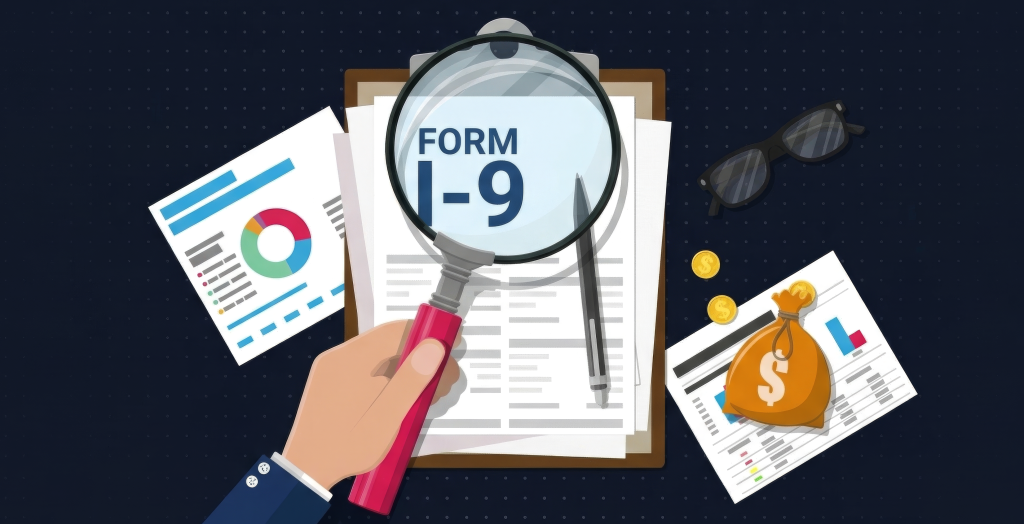
There is a version of I-9 compliance that most HR teams believe they have, and there is the version that would actually survive an ICE inspection.
The gap between them is rarely about intent. It is almost always about process — specifically, about what happens when the person who knows how to do I-9s correctly is on leave, has left the company, or is managing ten other things on a busy onboarding day. It is about whether the process is documented well enough that a line manager at a remote office can execute it correctly without calling HR. It is about whether anyone has looked at the forms completed five years ago under a different HR team using a form version that was superseded eighteen months later.
In the current enforcement environment — with ICE auditing at historically elevated rates and penalties assessed per form — the cost of that gap is no longer theoretical.
This is the operational playbook for closing it.
Starting Point: The Most Common Violations and Why They Happen
Before building a better process, it helps to understand exactly where the existing one tends to fail. A review of typical I-9 audit findings points to a consistent set of recurring violations.
Missing forms. A current employee for whom no I-9 exists is among the most serious violations. It typically happens during rapid growth phases, acquisitions where employee records are transferred incompletely, or periods when onboarding was handled informally. There is no corrective option for a missing form — the employer either has the form or doesn’t.
Section 1 completed late. The employee must complete Section 1 on or before their first day of work. Forms completed after the first day are a violation. This is often caused by onboarding processes that treat I-9 as an administrative afterthought rather than a day-one legal requirement.
Section 2 completed late. The employer must complete Section 2 within three business days of the employee’s first day. Missing this deadline is common when onboarding is decentralised and the person responsible for completing Section 2 is not the person managing the hire.
Incorrect or missing dates. One of the most frequent technical violations — dates entered in the wrong format, dates that don’t correspond to the hire date, or dates left blank entirely. Small errors, but assessed as violations per form.
Wrong form edition. USCIS periodically updates the I-9 form. Forms completed using a superseded edition during a period when a newer edition was required are technical violations. The most recent edition is dated 01/20/25 with an expiration date of 05/31/2027.
Missing employer signature. Section 2 requires the employer representative to sign and date the form certifying that documents were examined. Missing signatures are among the most common corrections identified in self-audits.
Incorrect document recording. Document type, issuing authority, document number, and expiration date must all be recorded accurately in Section 2. Abbreviations, illegible entries, or incomplete information are violations.
Reverification not completed. Where a worker’s employment authorisation has an expiration date, the employer is required to reverify before that date. Failing to reverify — often because no system exists to track expiration dates — is a violation that becomes a knowing-employment violation if work continues after authorisation has lapsed.
The Day-One Onboarding Process
A compliant I-9 process begins at offer acceptance, not on day one. The clearest way to prevent late Section 1 completion is to make I-9 paperwork part of the pre-start onboarding sequence.
At offer stage, send the employee a clear communication explaining that Form I-9 must be completed on or before their first day, what documents they can present (with reference to the official List of Acceptable Documents), and whether your organisation is using electronic I-9 software or paper forms.
On day one — before any work begins, or at the very latest by the end of the first day — Section 1 should be complete. If the employee is completing it on paper, a member of the HR or onboarding team should be available to assist. If using electronic I-9 software, the employee’s access to the form should be triggered immediately on acceptance.
Within three business days, the employer completes Section 2. This requires a designated, trained individual to physically examine the original documents presented by the employee — or, if the employee is remote, to conduct a live video examination under the alternative procedure.
The critical process control here is accountability: every I-9 should have a named individual responsible for completing Section 2, a deadline based on the specific hire date, and a confirmation step that records completion. In organisations where this is left to whoever is available, documentation quality deteriorates rapidly.
Remote Hires: The Alternative Procedure Done Correctly
Since the end of pandemic-era flexibility, the only permissible remote verification option for new hires is the DHS alternative procedure. Using it correctly requires the following:
The employer must be enrolled in E-Verify. This is a hard prerequisite — the alternative procedure is not available to employers who are not E-Verify participants.
The employer must designate an authorised representative to complete Section 2. This can be any person the employer designates — they do not need to be an employee or an HR professional. But they must be trained on the procedure.
The verification must be conducted via live video interaction. The employee presents their original document or documents to the camera. The designated representative examines them live and records the document information. A pre-recorded video, photographs, or copies of documents do not satisfy the requirement.
Section 2 must be annotated to indicate that the alternative procedure was used — specifically, the words “Alternative Procedure” should be noted in the Additional Information field.
The employer must retain a copy of the documents examined. This is a specific record-keeping requirement under the alternative procedure that does not apply to in-person examination.
Common failure points: employers who are not enrolled in E-Verify using video anyway and believing it is compliant. Designated representatives who were informally told to “do the video call” but received no formal training on the requirements. Failure to annotate the form or retain document copies.
If your organisation has been using remote video verification without being enrolled in E-Verify, those I-9s are non-compliant and should be assessed as part of a self-audit.
Managing TPS and Expiring Work Authorisation
Reverification is the area of I-9 compliance that is creating the most acute operational challenges in 2026, specifically because of the volatility around Temporary Protected Status.
The first step is knowing which of your current employees hold work authorisation that has an expiration date. US citizens and lawful permanent residents (Green Card holders) generally do not require reverification — a Green Card does not expire for I-9 purposes even if the physical card has an expiry date. But employees who are authorised to work based on a visa status, TPS designation, or other time-limited grant of authorisation must be reverified before their authorisation lapses.
Building an expiration tracking system is not optional infrastructure. At minimum, this means a spreadsheet or HRIS field that captures the work authorisation expiration date for every employee whose authorisation has one, with automated reminders triggered at 90 days, 60 days, and 30 days before expiry.
For TPS holders specifically, the picture is complicated by active litigation. Several TPS terminations announced in 2025 have been stayed by courts — meaning the designation technically continues while litigation proceeds. For employers, the practical approach is to monitor the USCIS I-9 Central website for updates on each TPS country, consult with employment counsel before taking any adverse action based on TPS status, and document that you are actively monitoring.
If you are enrolled in E-Verify, check the Status Change Report regularly. DHS introduced this report specifically to help E-Verify employers identify workers whose EADs have been revoked — it is an active compliance tool, not a set-and-forget alert.
The Self-Audit: How to Run It
A self-audit conducted before an ICE inspection is one of the most valuable compliance investments an organisation can make. The methodology is straightforward, though the execution requires time and attention.
Step 1: Establish the complete roster. Generate a list of every current employee and any former employee whose I-9 must still be retained. I-9 retention requirements run for the longer of three years from the date of hire or one year from the date of termination — a former employee terminated two years ago for whom the I-9 must still be kept is within the audit scope.
Step 2: Confirm every form exists. Match the roster against your I-9 file. Any current employee for whom no I-9 exists is a critical finding. A new I-9 cannot retroactively cure a missing form, but it must still be completed for the employee going forward.
Step 3: Review each form for technical violations. Work through each form systematically against a checklist: Section 1 completed and dated on or before first day; Section 2 completed within three business days; employer signature present; document information recorded completely and legibly; correct form edition for the hire date; no impermissible information recorded.
Step 4: Document corrections appropriately. Correctable technical errors in existing I-9s should be corrected using a specific method: draw a single line through the error, enter the correct information, initial and date the correction. Do not use correction fluid. Do not erase. The original entry must remain legible.
Step 5: Review the reverification schedule. Identify all employees with expiring work authorisation and confirm reverification has been completed or is scheduled before expiry dates.
Step 6: Document the audit itself. Record that the audit was conducted, by whom, when, what was found, and what corrective action was taken. This documentation is evidence of good faith in the event of a subsequent government audit.
If ICE Arrives
Despite best preparation, enforcement visits happen. Every organisation should have a documented response plan before one does.
The plan should designate a point of contact — typically the head of HR or General Counsel — who is notified immediately when federal agents arrive at any facility. Front-desk and reception staff should be trained on the protocol: be courteous, do not obstruct, and call the designated contact immediately.
Employers are entitled to ask to see the legal authority under which agents are operating. An I-9 inspection typically begins with a Notice of Inspection, which provides three business days to produce I-9 forms for inspection. You are not required to surrender I-9s on the spot without a Notice of Inspection.
Use the notice period. Contact employment counsel immediately. Do a rapid review of the I-9 file for the employee population covered by the notice. Do not alter, destroy, or otherwise interfere with records — that creates criminal exposure separate from any underlying compliance issues.
Cooperate fully. Employers who are uncooperative, evasive, or obstructive during audits receive the minimum good-faith credit in penalty calculations. Employers who cooperate professionally, present organised records, and demonstrate a genuine compliance programme receive the maximum credit.
The Global Parallel
The specific mechanics of Form I-9 are US-specific, but every jurisdiction in which global employers operate has an equivalent obligation. In the UK, the right-to-work check framework requires employers to examine original documents, record specific information, and retain copies — with a statutory excuse against civil penalty only available to employers who completed a compliant check before employment commenced. Fines run to £60,000 per illegal worker.
In the UAE, the system of employment visas and labour cards creates a continuous employer obligation to ensure workers remain within the terms of their permitted employment. In Singapore, the Employment Pass and S-Pass frameworks carry employer sponsorship obligations and renewal monitoring requirements.
The common thread: employment eligibility verification is the employer’s legal responsibility, the documentation requirements are specific and auditable, and enforcement is intensifying globally.
The organisations that will navigate this period without significant disruption are those that treat workforce eligibility verification as a live, ongoing compliance discipline — not a box ticked at hire that never needs to be looked at again. In 2026, the cost of the alternative is simply too high.
AMS Inform provides background verification and workforce screening services across 160+ countries. For organisations looking to strengthen their employment eligibility verification frameworks, speak to our team at AMSinform.com.