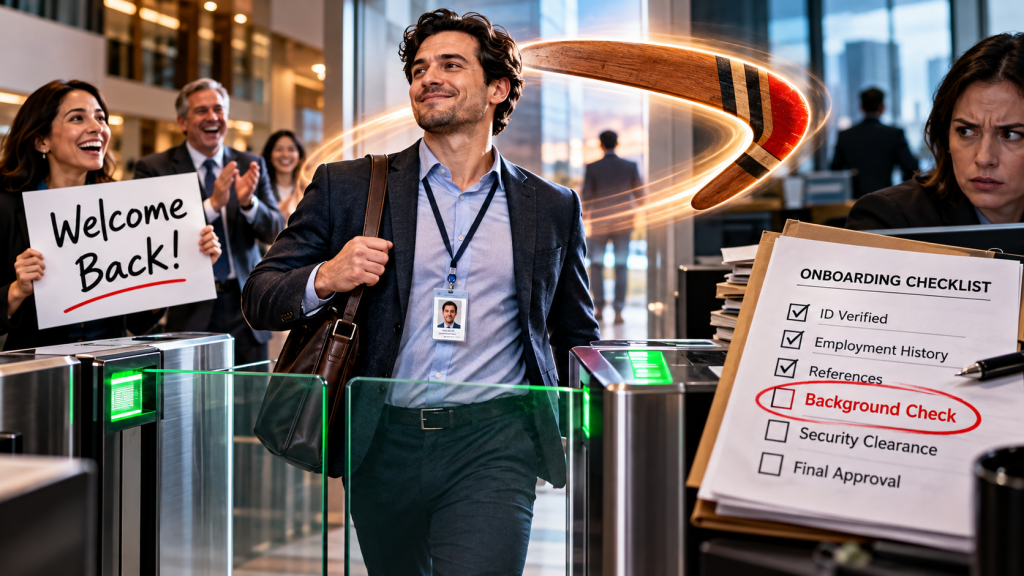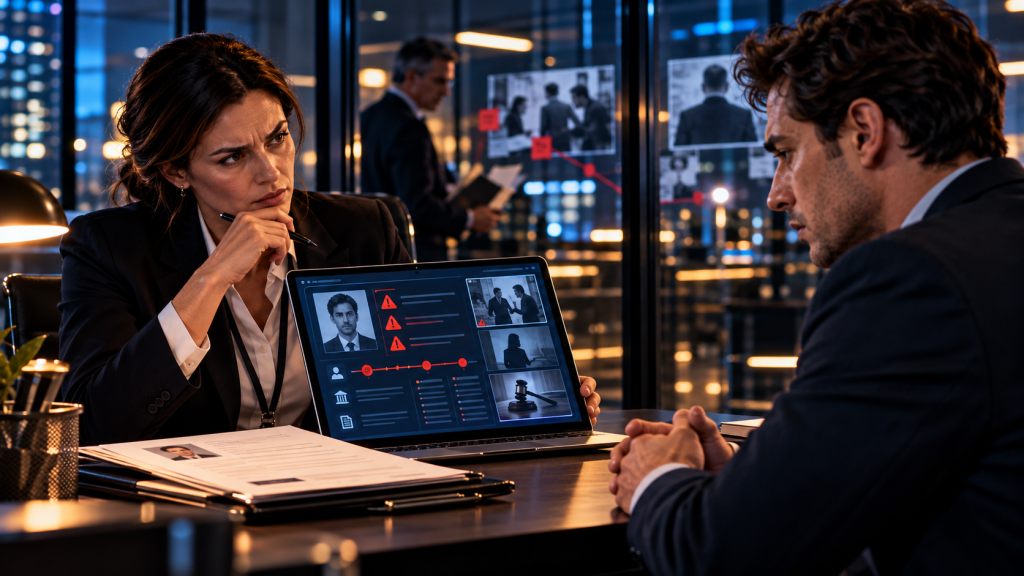
In late 2024, a cybersecurity company called KnowBe4 — whose product is, quite literally, training other companies to recognise and resist social engineering — discovered that the senior software engineer they had hired six weeks earlier was a North Korean operative. The discovery happened only because the operative attempted to install malware on his company-issued laptop during his first week of work, which triggered automated security alerts. By the time the company’s IT team had locked down the workstation and convened an investigation, the operative had already cleared four rounds of video interviews, a pre-employment background check, and a standard new-hire onboarding process. None of those controls had detected him.
The KnowBe4 case has become a reference point in the DPRK IT worker conversation because of who the victim was. If a company that sells anti-social-engineering training to other companies can be fooled, the comfortable assumption that “our process would have caught it” needs to be examined more carefully. The honest assessment most CHROs and CISOs arrive at, when they do examine it, is that their process probably would not have caught it either.
What this blog is about is what to do about that. The DPRK threat is the most visible illustration of a broader gap in remote-hire verification, but the gap is real regardless of which adversary is exploiting it. Closing it requires changes across the full hiring lifecycle — pre-application screening, identity proofing, interview discipline, post-hire monitoring, and contractor oversight — and the changes have to be coordinated across HR, security, legal, and procurement. No single function can close the gap on its own.
This is a 2026 playbook based on what is actually working in the organisations that have done the work, what the FBI, Microsoft, Unit 42, and other primary sources have published as detection guidance, and what AMS Inform has observed across its own client base. It is structured by lifecycle stage. Each section identifies the gap in the standard approach, the operational change that closes it, and the practical implementation considerations.
Stage One: Pre-Application Screening
The first opportunity to catch a DPRK-style infiltration is upstream of the formal application — at the point where candidates first enter the funnel. Most organisations do nothing here. The assumption is that the recruiting team’s job is to attract candidates, and the screening for legitimacy happens later. That assumption needs to change.
The single most impactful pre-application control is requiring that all applications for remote roles come through a verified channel — either a direct corporate application portal with identity-anchored login, or a staffing partner whose own identity verification practices have been independently assessed. Applications received through generic email channels, unverified freelancer platforms, or third-party staffing firms with opaque vetting should be flagged for enhanced review before they enter the pipeline at all.
Microsoft’s 2026 detection research documented a specific pre-application signal that most HR teams are not monitoring: automated queries against the company’s Workday recruiting API from infrastructure linked to known DPRK operations. The pattern looks like programmatic scanning for open roles before any human applicant interacts with the platform. Security teams that monitor authentication and API access logs against their HR SaaS environment can detect this in real time, but the detection only works if HR and security are sharing telemetry. In most organisations, they are not.
A second pre-application control is reverse image verification on resume and LinkedIn profile photographs. AI-generated profile imagery has become significantly harder to detect by visual inspection alone, but reverse image search will reliably catch reused stock photographs, lightly modified images that appear elsewhere on the web, and certain categories of AI-generated faces that share underlying generative patterns. The check takes a recruiter less than thirty seconds per candidate and catches a meaningful percentage of the cruder synthetic personas.
Stage Two: Identity Proofing
The most important architectural change for remote hiring in 2026 is moving identity proofing from a document-based to a presence-based model. The document check — confirm that the driver’s licence is valid, that the SSN matches the date of birth, that the address history is plausible — is still useful, but it is no longer sufficient. The reason is that DPRK operatives have specifically built their operation around producing identities that pass document checks. Stolen but legitimate US personal data, combined with forged but technically accurate state-issued IDs, will clear every document-based verification system in production today.
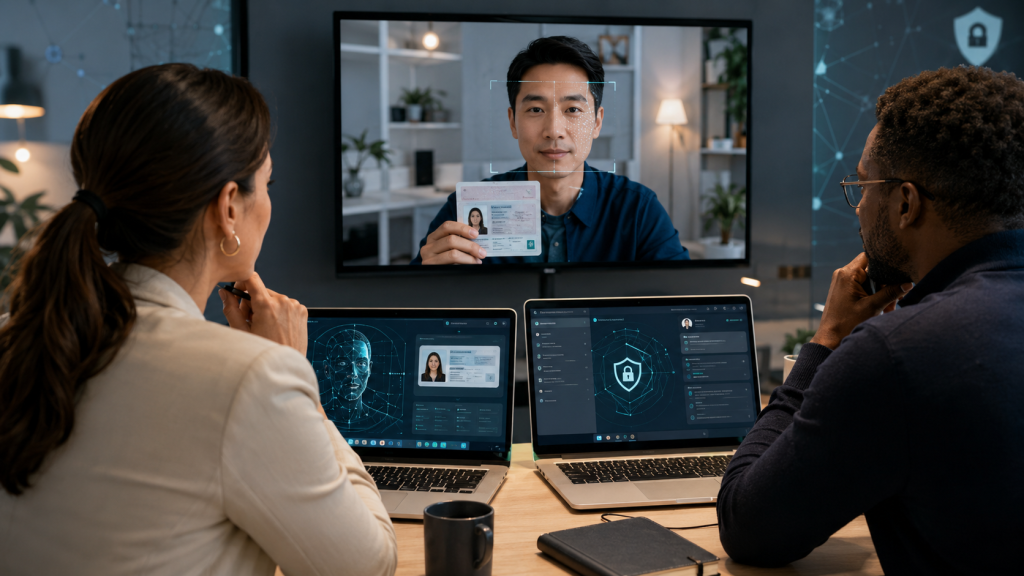
What closes the gap is biometric identity proofing tied to a live capture, performed at the time of hire by an identity verification service that the company controls. The candidate is asked to photograph a government-issued ID. The document is checked for tampering, expiration, and country-specific security features in real time. The candidate is then prompted to record a short selfie video, which is checked for liveness — that is, evidence that a real human face is present rather than a static photograph, deepfake replay, or screen recording — and compared against the photograph on the ID document.
This is not a perfect control. Real-time deepfake technology continues to improve, and a sufficiently capable operative may eventually defeat liveness detection. But it is a substantially harder control to defeat than document review, and it forces the operative to either commit additional fraud (which produces additional artefacts that downstream controls can detect) or abandon the application. In the cases AMS Inform has worked, biometric identity proofing has materially reduced the rate at which suspect applications progress to the offer stage.
For the highest-risk remote roles — engineering positions with access to source code, anyone touching financial systems or customer data, contractors working with regulated information — biometric proofing alone is not enough. The next level is in-person identity verification at hire. The candidate is required to physically present themselves at a designated verification location, either a corporate office, a partner location, or an in-person identity verification service, and complete the document verification face-to-face. This is operationally heavier and creates friction in the hiring process, but it is essentially impossible to defeat with the current generation of synthetic identity tradecraft. For roles where the cost of an infiltration is high, the friction is justified.
Stage Three: Interview Discipline
The interview process is where most organisations assume they have the strongest control, and where the gap has actually opened most quickly. The combination of consumer-grade real-time deepfake software, AI-scripted responses, and well-rehearsed technical material has made it possible for a competent operative to pass multi-round technical interviews without a real person ever appearing on camera.
Three operational changes close most of the gap.
The first is live, unfiltered video for all remote candidate interviews. This means no virtual backgrounds, no third-party camera filters, no platform-level beauty filters, no green-screen replacement. The candidate must appear on a standard camera in a verifiable environment, and the interviewer should be able to see context cues — wall behind the candidate, lighting in the room, ambient details — that would be technically difficult to fabricate consistently across multiple sessions. Most video platforms allow administrators to disable virtual background features at the meeting level. Doing so should be a default for hiring interviews.
The second is unscripted identity challenges during the interview. The interviewer asks the candidate to turn their head sharply to one side, then back. Asks them to pick up a piece of paper from off-screen. Asks them to hold a hand in front of their face and remove it. These movements are easy for a real person and produce visible artefacts when a real-time deepfake is in use — temporal inconsistencies, occlusion handling failures, audio-visual synchronisation problems. The artefacts are subtle, but trained interviewers can spot them. Even when an operative passes the immediate challenge, the cognitive load of running a deepfake while answering interview questions tends to produce other observable signals: longer-than-natural pauses, mismatched facial expression timing, occasional voice-video desynchronisation.
The third is at least one in-person interaction before final hire for any role that will have access to sensitive systems. This can be an in-person final-round interview, a mandatory orientation, or an in-person identity proofing session. The operational cost is real, but the controls upstream — biometric proofing, video discipline, behavioural analysis — combined with this physical-presence requirement produce a layered defence that is significantly harder to defeat than any of them individually.
Stage Four: Post-Hire Monitoring
Even with all of the above, some operatives will get through. The question becomes what visibility exists into the worker’s behaviour and infrastructure once they are inside the organisation. This is where the laptop farm pattern becomes detectable.
The single most reliable post-hire indicator of DPRK IT worker activity is a mismatch between the address on the worker’s identity documents and the physical address from which the company-issued device operates. The address on the ID is in California; the laptop is being used from Pennsylvania. The address on the W-4 is in Arizona; the network connection is consistently routed through a residential IP block in Indiana. These mismatches are not perfectly diagnostic — there are legitimate explanations for short-term inconsistencies — but as a persistent pattern they are an extremely strong signal.
Building this detection requires three pieces of telemetry that most HR and IT teams do not currently correlate. First, the worker’s documented home address, captured at onboarding. Second, the physical shipping address to which company-issued devices are sent, captured by IT procurement. Third, the network egress data showing where the device is actually connecting from, captured by security or network operations. In most organisations these three data points sit in three different systems owned by three different teams and are never compared. The change that needs to happen is making the comparison automatic and flagging mismatches for review.
Behavioural analytics post-hire add a second layer. Indicators include impossible-travel patterns — logins from physically distant locations within timeframes that would not allow legitimate travel — extended periods of activity during local night hours combined with quietness during local business hours, productivity anomalies such as identical code commits across multiple workers managed by different facilitators, and unusual patterns of access requests that suggest the worker is trying to expand their permissions beyond their stated role.
For high-risk roles, periodic “surprise verification” interactions are an additional control. A manager schedules an unannounced video check-in, requests an unscripted on-camera task, or asks for a brief in-person meeting. The objective is not to interrogate the worker but to confirm that the person performing the work is the person who was hired. Legitimate workers find this slightly awkward but tolerate it; operatives, particularly those running multiple roles in parallel, often produce telltale evasion patterns.
Stage Five: Contractor and Vendor Extension
The DPRK threat has expanded well beyond direct hires. The fastest-growing vector in 2025 and 2026 has been third-party arrangements — staffing firms, freelancer platforms, outsourced development shops, and contractor agencies whose own verification practices are opaque or weak. Operatives have learned to route applications through intermediaries whose vetting is less rigorous than the end client’s, knowing that the end client will accept the intermediary’s verification as sufficient.
Closing this gap requires extending the verification architecture beyond the boundary of direct hires. Contracts with staffing firms and contractor agencies should require — in writing — that the agency conduct biometric identity proofing, sanctions screening, and address verification on each worker placed; that the agency provide attestation that the worker performing the contracted work is the same individual the agency screened; and that the end client retains the right to conduct independent verification on any worker.
Freelancer and gig platforms used for short-term technical engagements should be evaluated against the same standard. The defensive posture cannot be “we used a reputable platform”; it has to be “we know how this platform verified this specific worker.” For sensitive work, freelancer arrangements should be replaced with direct contracting that allows the full verification stack to be applied.
The Legal Exposure
The DPRK IT worker question is not only an operational one. It carries significant legal exposure that most companies have not adequately mapped.
Sanctions risk is the most direct exposure. Paying wages to a sanctioned country — even unknowingly — can trigger OFAC enforcement, including substantial civil penalties. The OFAC position on inadvertent sanctions violations is that the absence of intent is mitigating but not exculpatory; organisations are expected to have implemented reasonable controls to detect and prevent prohibited transactions, and “we did not know” is not a defence if the controls were inadequate.
Export control risk applies for any organisation working in defence, aerospace, semiconductors, dual-use technology, or other ITAR-regulated or EAR-regulated industries. Granting a DPRK national access to controlled technology or technical data — even through a successful infiltration — can constitute an export violation, with associated criminal penalties.
Data protection and breach notification risk applies whenever an infiltrated worker has accessed personal data that the organisation holds. Many DPRK operations exfiltrate data once they are inside, and the operation has increasingly used that data for extortion. The cost of breach notification, regulatory penalties, and litigation can substantially exceed any direct financial loss.
Civil exposure to the individuals whose identities were used by the operatives is an emerging risk. As awareness of the scheme grows, victims of identity theft are likely to seek recourse against the companies that paid wages to operatives using their identities, on theories of negligent verification.
The mitigating factor across all of these is documented good-faith implementation of reasonable verification controls. Organisations that can demonstrate they have built a layered remote-hire verification architecture, that they continuously monitor for known indicators, and that they have responded promptly to any signals of infiltration are in materially stronger position than organisations whose controls have not evolved past 2019.
The Cross-Functional Question
The single most important point in any 2026 remote-hire verification programme is that it cannot be owned by HR alone. The signals that catch DPRK operatives sit across multiple systems owned by multiple functions: HR holds the identity documents, IT holds the device telemetry, security holds the network and access logs, procurement holds the vendor relationships, and legal holds the exposure picture. None of these functions, operating in isolation, can build the detection architecture that catches the threat.
The organisations that have done this work well have constituted a standing cross-functional team — typically anchored by a head of HR operations and a CISO designee — with explicit responsibility for the remote-hire verification programme. The team meets regularly, owns the shared detection metrics, reviews incident response retrospectives, and updates the architecture as the threat evolves. Where this team does not exist, the remote-hire verification gap tends to remain open even when individual functions have done good work in their own scope.
The Forward Question
The DPRK IT worker scheme has been the trigger for most of the remote-hire verification work happening in 2026. But the underlying vulnerability — the gap between a verifiable identity and a verified human, sustained across the employment lifecycle — is much broader than this one adversary. Other state actors have already begun adapting the same techniques. Commercial fraudsters are using the same AI-enabled tooling for non-state-affiliated employment fraud. The infrastructure of synthetic identity, deepfake interviews, and laptop farms is now part of the global hiring ecosystem and will be exploited by an expanding set of actors.
The organisations that build a 2026-grade remote-hire verification architecture are building defence in depth against a category of threat that will outlast North Korea. The organisations that don’t are leaving open a vector that has now produced 479 documented corporate victims, with the actual number significantly higher and growing.
The right time to close the gap was three years ago. The next-best time is now.
AMS Inform provides background verification and workforce screening services across 160+ countries. To assess your remote-hire verification architecture against the current threat environment, visit AMSinform.com.