In May 2025, Homeland Security Investigations agents visited more than one hundred restaurants in Washington DC for Form I-9 inspections. In January 2026, ICE conducted three separate enforcement visits to DR Horton homebuilder construction sites in Minnesota. A Hyundai parts supplier in Alabama saw 475 workers detained in a single operation. A racetrack in Louisiana had over one hundred workers taken in one day.
These weren’t isolated incidents. They were signals.
According to enforcement data published in early 2026, ICE conducted more than 4,000 I-9 audits in 2025 — a significant escalation from prior years. Current projections indicate the pace is increasing. A DHS attorney cited in HR Dive described the situation plainly: “2025 was the year to lay the groundwork. 2026 will be the year they are focused on large-scale enforcement activity.”
For HR and compliance teams across the US, the question is no longer whether enforcement will reach their industry or company size. It is whether their I-9 process would survive scrutiny if it arrived today.
What Form I-9 Actually Requires
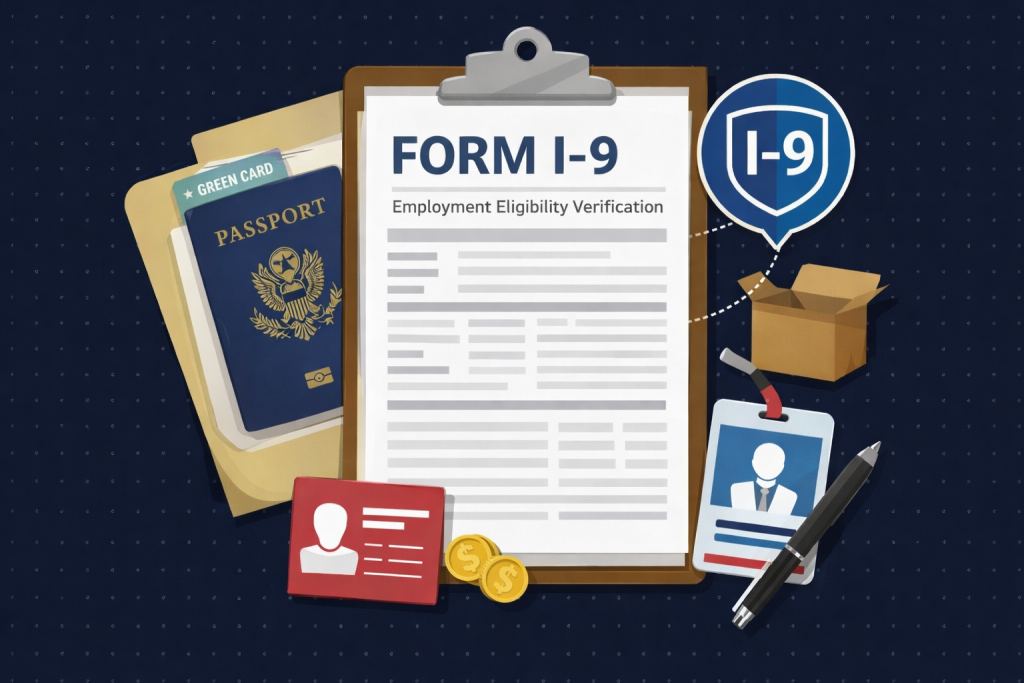
Every employer in the United States is required to complete and retain a Form I-9 for every individual hired for employment after November 6, 1986, regardless of the worker’s citizenship or national origin. The form has three sections.
Section 1 must be completed by the employee on or before their first day of work. It captures basic identity information and requires the employee to attest to their employment authorisation status.
Section 2 must be completed by the employer within three business days of the employee’s first day of employment. The employer must physically examine original documents presented by the employee — from the lists of acceptable documents — and record specific information from each document, including the document type, issuing authority, document number, and expiration date.
Section 3 covers reverification and rehires. When an employee’s work authorisation expires, the employer must reverify before the expiration date. If an employee is rehired within three years of the original I-9 date, a new form is not always required.
The procedural requirements sound straightforward. The compliance failures emerge in execution, at scale, across a workforce hired over many years by different people in different offices with varying levels of training.
The Most Common Violations — and What They Cost
The 2026 penalty schedule, adjusted for inflation under the Federal Civil Penalties Inflation Adjustment Act, is as follows:
Paperwork violations — missing signatures, incorrect dates, wrong form edition, incomplete fields — attract fines ranging from $288 to $2,861 per form. Penalties are assessed per individual I-9, not per audit. An organisation that has employed several hundred people over its history and has never conducted a self-audit is carrying unknown exposure in its filing system.
Knowingly employing an unauthorised worker carries fines of $698 to $5,724 per worker for a first offence. Second offences run $5,724 to $14,305. Third and subsequent offences reach $9,551 to $28,619 per worker. There is a five-times increase between a first and third offence — a fact that makes any employer with prior violations acutely vulnerable in the current enforcement environment.
Document fraud — presenting false documents, or document abuse such as requiring more documentation than the form calls for — carries its own penalty schedule: $590 to $4,730 per fraudulent document for a first offence, scaling to $3,795 to $9,463 for subsequent violations.
Beyond the financial penalties: employers found in violation can be debarred from federal contracts. Patterns of knowing violations can trigger criminal liability. And enforcement actions have a documented tendency to cascade — an I-9 audit that uncovers violations can trigger broader investigations into wage and hour practices, worker classification, and other employment compliance areas.
The TPS Termination Problem Nobody Was Ready For
The most acute compliance challenge emerging in 2026 is not the pre-hire I-9 process. It is the reverification of workers whose employment authorisation has changed — or is about to change — mid-employment.
Temporary Protected Status (TPS) provides temporary work authorisation to nationals of countries designated by the Department of Homeland Security as experiencing armed conflict, natural disasters, or other extraordinary conditions. In 2025 and early 2026, the current administration moved to terminate TPS designations for multiple countries: Haiti, Venezuela, Honduras, Nepal, Nicaragua, Somalia, and Yemen among them. Each termination has been subject to litigation, court orders, stays, and further appeals — creating a state of genuine operational uncertainty for employers.
The practical consequence is this: an employer may have a worker whose Employment Authorisation Document (EAD) was valid at the time of hire and whose I-9 was completed correctly. That worker’s authorisation may now have terminated — or may terminate on a specific upcoming date — depending on the outcome of ongoing litigation they have no ability to control.
DHS introduced a Status Change Report in June 2025 for E-Verify employers, identifying previously verified employees whose EADs have been revoked. E-Verify employers are required to review this report periodically, notify affected employees, and complete reverification where required. Employers not enrolled in E-Verify have no equivalent automated alert — they must be tracking expiration dates manually and monitoring TPS developments for the nationalities represented in their workforce.
For HR teams managing diverse, international workforces, this is not a theoretical concern. It is an active operational task that most organisations are underprepared for.
The Remote Hire Compliance Gap
The pandemic-era I-9 flexibility that allowed employers to remotely inspect documents via video has ended. Since August 2023, employers who use the remote verification option for new hires must follow the DHS alternative procedure — which requires the employer to be enrolled in E-Verify, have trained their staff on the procedure, and maintain records documenting that live video examination of original documents was completed.
In practice, this creates risk at several points.
Employers who were using pandemic-era video flexibility and did not transition properly to the formalised alternative procedure are potentially non-compliant for every remote hire completed under those arrangements.
Employers who are growing rapidly and onboarding remote employees across multiple locations often delegate I-9 responsibility to managers or office coordinators who have not been trained on the alternative procedure requirements. The documentation standards for remote verification — specifically the requirement to retain evidence of the remote examination — are frequently not met.
And employers with hybrid or distributed workforces who have not clearly established which hires are being processed remotely versus in-person risk inconsistent treatment that becomes difficult to defend if audited.
The State-Level Complexity Layer
Federal I-9 requirements apply to all US employers. But the compliance landscape is further complicated by an accelerating patchwork of state-level E-Verify mandates.
E-Verify is the federal online system that allows employers to electronically confirm a new hire’s work eligibility against Social Security Administration and DHS databases. Federal law requires E-Verify participation for federal contractors and subcontractors. Several states have gone further.
In October 2025, Iowa’s Governor issued an executive order requiring state government departments to use E-Verify for all new hires. In December 2025, Ohio passed the E-Verify Workforce Integrity Act, effective March 2026, mandating participation for nonresidential construction employers, including subcontractors and labour brokers. Penalties for knowing violations include permanent licence revocation. Under-compliance fines reach $25,000 per continuing violation.
These state mandates matter for two reasons. First, they impose obligations that don’t exist under federal law for employers who fall within their scope. Second, they signal a direction of travel: states are actively moving to expand E-Verify requirements, and the administrative and operational burden of compliance with a non-uniform patchwork of state laws is a real challenge for employers operating across jurisdictions.
Importantly: E-Verify participation does not replace the I-9 requirement. Employers enrolled in E-Verify still must complete I-9 forms correctly and retain them. E-Verify is an additional layer, not a substitute.
What a Genuine Pre-Audit Review Looks Like
The single most valuable step any employer can take in the current enforcement environment is conducting a comprehensive internal I-9 audit before receiving an inspection notice from ICE.
Why before? Because employers who proactively identify and correct I-9 errors prior to a government audit receive the maximum good-faith reduction in penalty calculations. ICE’s penalty methodology explicitly accounts for employer good faith — defined in part as having established a compliance programme and taken steps to correct identified violations. An employer who presents a clean, audited I-9 file to investigators is in a materially different position than one who presents a filing cabinet of unreviewed forms.
A genuine pre-audit review covers several things. First, the inventory: establishing a complete list of current employees and former employees for whom I-9s should exist. Missing forms for current employees are among the most serious violations — there is no good-faith defence for a missing form.
Second, the document review: examining each form for the most common technical violations — missing or incorrect dates, absent employer signatures, incomplete document information in Section 2, wrong form editions for the relevant hire date. These are correctable prior to an audit if handled correctly and documented properly.
Third, the reverification review: identifying all employees whose work authorisation is due to expire, or who are TPS holders from affected countries, and establishing a reverification schedule.
Fourth, the process review: evaluating the current onboarding process for new hires to identify where I-9 errors are most likely to originate and correcting those process gaps going forward.
An audit is not just risk mitigation. For companies where I-9 compliance has never been a focus, it is usually the first accurate picture of actual exposure — and that information, however uncomfortable, is better to have than to discover during an enforcement action.
The Global Dimension
The I-9 enforcement story is US-centric, but the underlying principle — employer responsibility for verifying workforce eligibility — is universal.
In the UK, right-to-work checks are a legal obligation for every employer. The Home Office conducts compliance visits, and civil penalties for employing someone without the right to work run up to £60,000 per illegal worker. A statutory excuse against civil penalty exists only if the employer completed a compliant right-to-work check before the employment commenced. The UK’s expansion of digital identity verification through certified identity service providers has changed how those checks can be completed — but not the obligation to complete them.
In the UAE, employment visa verification and the Wages Protection System create employer obligations around workforce documentation that are actively enforced. In India, the introduction of the Digital Personal Data Protection Act has added a consent and data-handling dimension to the candidate documentation processes that underpin employment verification.
The common thread across jurisdictions is accelerating enforcement. The era of governments treating workforce verification compliance as a background administrative matter is ending. The employers who will navigate this period well are those who treat workforce eligibility verification with the same rigour they apply to their financial compliance obligations — because in most jurisdictions, the consequences of getting it wrong are now similarly material.
AMS Inform provides background verification and workforce screening services across 160+ countries. For organisations reviewing their employment eligibility verification processes, speak to our team at AMSinform.com.