A payslip is testimony. It is the candidate’s account of what they were paid, produced on demand, from a source the candidate controls. Verification, properly understood, is the search for receipts: records of the same money created by parties with no stake in the negotiation.
For salary, those receipts exist in unusual abundance, because formal employment in India leaves statutory fingerprints everywhere: in the tax system, in the provident fund, in the arithmetic of the payslip itself. What follows is the operational sequence for using them, ordered for efficiency, wrapped in the two disciplines that keep the whole exercise defensible: knowing where you may still ask the question at all, and adjudicating what you find with a sense of proportion.
First, Decide Whether You May Ask
Before designing a verification step, check whether the question survives contact with your hiring map.
More than twenty US states and many cities prohibit asking candidates about salary history. In the EU, the Pay Transparency Directive’s transposition deadline passed on 7 June 2026, and its core obligations include a complete ban on pay history questions at any stage of recruitment, alongside mandatory disclosure of the role’s pay range. Member state implementation is uneven, but the Commission has ruled out extensions and the direction is fixed, and the ban extends to indirect routes: sourcing the same information through reference checks is not a loophole, it is the same breach with extra steps.
So build a jurisdiction matrix before anything else. Where the question is banned, remove compensation history from forms, train recruiters off the reflex, and price offers from bands. Where it remains lawful, everything below applies. A multinational needs both lanes, clearly marked, because the same diligence email that is routine in Gurgaon can be evidence against you in Berlin.
Go to the Tax Trail, With Consent
Where verification is lawful, start with the record the candidate cannot edit: the tax trail.
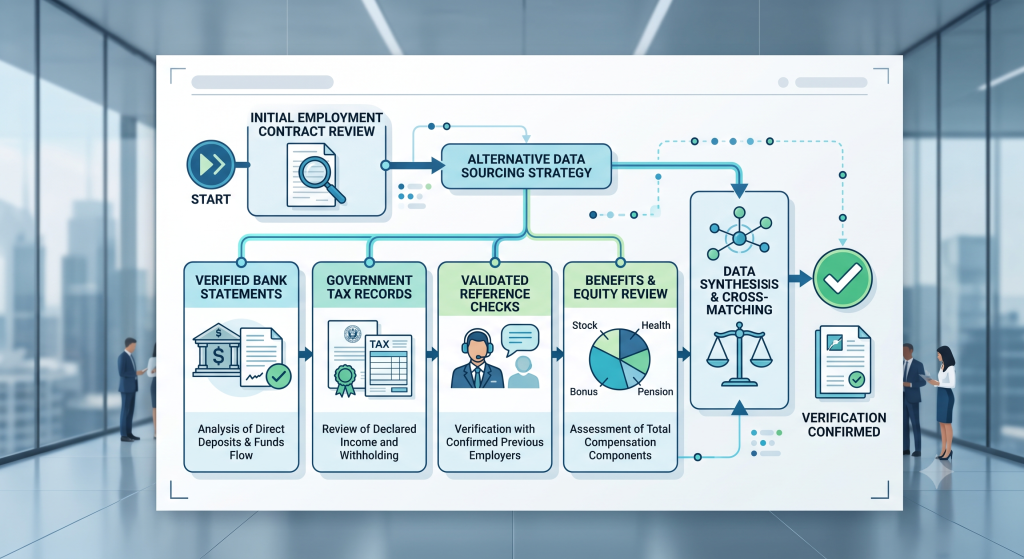
Every employer deducting tax on salary deposits it against the employee’s PAN, and that deposit surfaces in the employee’s Form 26AS and the fuller Annual Information Statement, both downloadable by the candidate from the income tax portal in minutes. With the candidate’s informed consent, reconciliation is straightforward: the employer names on the trail should match the CV, and the income figures should sit within a sensible distance of the claimed package. A Form 16 supplied by the candidate earns trust only after it agrees with 26AS, because a forged certificate cannot reach into the department’s ledger.
One calibration note keeps this honest: CTC and taxable income are not the same number. Employer provident fund contributions, gratuity provisions, exempt components, and the timing of variable payouts all open lawful gaps between the package and the tax figure. Set a tolerance band and investigate breaches of the band, rather than playing gotcha over differences that lawful structuring fully explains. The tax trail is there to catch invented salaries, not to punish real ones for being structured.
Use the Provident Fund as a Consistency Check
The second receipt is the provident fund record, and its correct use is as a consistency check rather than a salary meter.
Contribution amounts in the candidate’s passbook imply a basic salary, and a claimed package whose implied basic is wildly out of line with the contributions is asking a question that deserves an answer. The calibration matters here too: because statutory contributions can lawfully be computed on a capped wage base, modest contributions do not disprove a high salary. The signal runs the other way. Contributions consistent with a junior package sit awkwardly under slips claiming a senior one, and periods with no contributions at all sit awkwardly under slips claiming any salary whatsoever.
The same lookup, run at establishment level, also re-verifies that the paying employer is the claimed employer, which readers of the previous piece in this series will recognise as the fake-company check arriving for free. And concurrent contributions from two employers surface moonlighting without any additional effort.
Read the Payslip Against Its Own Arithmetic
The payslip itself still deserves examination, because fabricated documents are usually bad at mathematics.
A genuine Indian payslip is a web of published formulas: provident fund as a fixed percentage of basic, ESI applicability below a known gross threshold, professional tax at state-specific slabs, TDS that should reconcile with an annual income at the claimed level. Fabricators routinely produce slips whose deductions follow no formula at all: round-number salaries with no TDS, provident fund figures untethered to basic pay, net amounts that do not follow from the gross above them. Check the internal arithmetic before checking anything external, because a slip that fails its own maths has already confessed.
Two further tells help. Template fingerprints, the same layout and phrasing recurring across supposedly unrelated employers, indicate a common workshop. And bank statements showing salary credits can corroborate net pay in amount and rhythm, valuable as supporting evidence, never as proof, since statements are themselves editable documents.
Confirm With the Employer, Within Limits
Direct employer confirmation still has a role, played within two constraints.
The first is disclosure practice: many organisations will not reveal a former employee’s pay. Ask in confirmation form, whether gross pay fell within a stated band, rather than in disclosure form, and record what could and could not be confirmed rather than treating silence as either verification or guilt. The second is provenance, the standing rule from earlier in this series: every employer contact is sourced independently, never from the candidate’s paperwork, because a compensation confirmation from the fraud’s own front desk is worse than no confirmation at all.
Adjudicate the Spectrum, Not Just the Forgery
What the checks surface will range from innocent to criminal, and the programme’s credibility depends on telling them apart.
Define three tiers in advance. Lawful structuring: variable counted at target, one-time components annualised, ESOPs valued hopefully, resolved by clarification and repricing, not accusation. Material misrepresentation: claiming discretionary pay as fixed, inflating beyond any structural explanation, met with offer recalculation or withdrawal per stated policy. Fabrication: edited or invented documents, which is document fraud under the cheating and forgery provisions of Indian criminal law, and legal commentary is clear that even partial manipulation qualifies, warranting withdrawal or termination, and reporting where the organisation’s policy provides for it.
Write the tiers into policy, reference misrepresentation explicitly in offer letters, and apply the framework identically across seniority levels. An adjudication standard that flexes for senior hires is not a standard, and the following piece in this series will have more to say about how verification mysteriously softens as the salary rises.
Fix the Incentive While You Verify
Verification treats the symptom. The disease is the anchor, and it can be treated in parallel.
Every step toward pricing roles rather than histories shrinks the fraud’s audience: published or internal bands for each role, offers anchored to the band, negotiation conducted on the role’s market data rather than the candidate’s paperwork. Communicating this changes candidate behaviour directly, because the documented psychology of payslip inflation is fear, the belief that an honest number caps the offer. A candidate told that the offer is band-based has nothing to gain from a forged slip and a career to lose.
There is also a forward-compatibility dividend. Organisations that wean their compensation process off past-pay anchoring are, incidentally, building the exact process that European law now mandates and that other jurisdictions keep adopting. The direction of travel is unambiguous, and it points away from the payslip.
Collect Less, Hold It Briefly
Finally, the data discipline. Compensation records are among the most sensitive personal data a hiring process touches, and India’s DPDP regime expects consent, purpose limitation, and restraint to match.
Collect the minimum that resolves the question: if a tax-trail reconciliation settles the claimed package, there is no reason to warehouse six months of payslips and bank statements as well. Document the consent, restrict access to the adjudicators, retain only as long as the decision requires, and dispose of the rest securely. A verification programme that hoards salary data has simply created a second risk while managing the first.
The Number You Can Defend
The end state this playbook builds toward is simple to describe. Offers rest either on numbers that need no verification, because the role is priced on its own value, or on numbers verified against records no candidate can author: the tax trail and the statutory contributions, with the payslip retired from load-bearing duty and returned to what it should have been all along, a piece of supporting context.
Either lane produces the thing that matters: a compensation decision you can defend, to a CFO auditing payroll drift, to a team discovering each other’s salaries, or to a regulator asking why you asked. The one indefensible position is the default this series keeps finding at every stage of hiring: a consequential decision, resting its full weight on a document that anyone with a laptop can print.