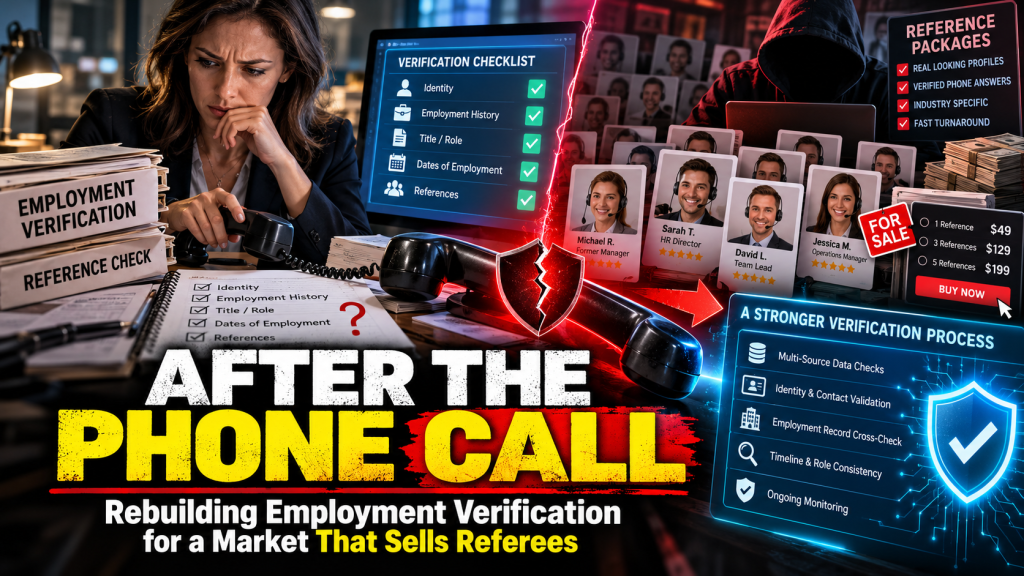
Nine hundred applications arrive for one posting. Two responses fail before they start. The first is heroic reading, which at any honest quality bar is arithmetic that does not work. The second is slop against slop: an AI screener rejecting at machine speed, which imports unreliability into decisions with legal consequences, and tells every genuine candidate in the pile that they were judged by a filter.
The way through is neither. The flood is a signal-processing problem, and the answer to a signal-processing problem is not more processing power aimed at noise. It is changing what counts as signal. This playbook builds that change in sequence: demote the text, restore a cost, anchor identity, verify claims early, and keep the whole thing fair enough that the candidates you actually want still finish the process thinking well of you.
Demote the CV From Decision Document to Claims Register
Start by being honest about what the CV now is. It is no longer evidence of effort, judgement, or writing ability, because a model supplies all three. What survives is its narrowest function: a structured list of factual claims, degrees, employers, dates, roles, each of which can be true or false.
So treat it that way. Stop soliciting the components AI has fully commoditised, beginning with the cover letter nobody writes and nobody reads. Define, for each role, the three to five claims that actually gate success, the qualification, the licence, the specific experience, and structure the application to capture them as checkable assertions rather than prose. You are not reading for impressiveness anymore. You are collecting testimony for verification, which is what the rest of this playbook does with it.
Put a Small, Honest Cost Back at the Gate
The application flood exists because applying became free. The first structural counter is to reintroduce a cost, deliberately, visibly, and calibrated.
The cost should be small, role-specific, and impossible to spray: a short answer that requires engaging with this role’s actual problem, a modest work sample drawn from the job’s real content, a confirmed scheduling step that a bulk tool will not complete. The purpose is not hazing and not volume suppression for its own sake. It is the restoration of a costly signal: completing the gate says “I want this job,” which is exactly the information the flood erased.
Be honest about the trade-off and manage it. Every ounce of friction loses some genuine applicants, and in scarce talent markets that loss is real. Calibrate by role: heavier gates where applications outnumber seats a thousand to one, lighter where you are the one courting. The discipline is that the friction must be meaningful to the role, or it is just an obstacle course, and candidates can tell the difference.
Anchor Identity Before Anyone Performs
The single highest-leverage verification step costs candidates two minutes and removes an entire category of flood: confirm, before assessments or interviews, that each candidate is a real, specific human being.
A lightweight identity verification, a government document authenticated and matched to a live capture, does three jobs at once. It deletes the fully synthetic fringe, the applications with no person attached, at the gate. It lays the anchor for interview and onboarding integrity, the same-face-at-every-gate chain this series set out in its proxy-fraud playbook. And it aligns with where the analyst guidance has landed: Gartner’s recommendation to employers is system-level validation, with identity verification and anomaly detection embedded in recruiting workflows rather than bolted on after offers. Platforms are moving the same way with verified profile badges, which you can treat as a useful early sorting signal while running your own anchor where it matters.
Genuine candidates barely notice this step; they have done it for every bank account they hold. The population that finds it fatal is precisely the population you want it to be fatal for.
Spot-Check Claims at the Shortlist, Screen Fully at the Offer
Here is the structural change the flood forces on screening: verification becomes two-tier.
The full background check stays where it belongs, post-offer, comprehensive, on one person. What moves forward is micro-verification at the shortlist: for the six people about to consume your interview loop, verify the two or three claims each of them most depends on. An employment history checked instantly against statutory contribution records. A degree confirmed with the issuing university. A licence validated at the register. Instant, authoritative checks have made this affordable at shortlist scale in a way that simply was not true when every verification meant a phone call and a week.
The economics justify themselves on the first catch. An interview loop costs a day of senior time per candidate; a fabricated shortlist candidate detected beforehand refunds all of it. And the deterrent compounds: a process known to verify at the shortlist stops attracting the fabrications at the application stage, which thins the flood at its source.
Use AI to Retrieve, Not to Adjudicate
None of this means refusing the machines. It means assigning them the work they are actually good at.
AI screening earns its keep in retrieval: searching the flood for candidates matching genuine requirements, the hidden-gem function that 60 percent of recruiters credit it with, surfacing people manual review would have missed. Where it fails is adjudication: rejecting humans at scale on model confidence, with error rates nobody has audited and reasoning nobody can explain. So draw the line there. Machines rank and retrieve; humans decide, especially at the rejection margin. Audit the tools for bias on a schedule, keep records of how automated recommendations are used, and note that the regulatory perimeter around automated hiring decisions is tightening in California and beyond, a topic this newsletter has covered in its own right. The flood does not suspend those rules. It makes the temptation to violate them stronger, which is exactly when written policy matters.
Protect the Genuine Candidate’s Experience
Remember the trust ledger while you build gates: only 26 percent of candidates trust AI to evaluate them fairly, a quarter trust employers less for using it, and offer acceptance has fallen from 74 to 51 percent in two years. Every control in this playbook can either worsen that or repair it, depending entirely on how it is communicated.
So communicate. Tell candidates what is automated and what is human, what will be verified and when, and what your policy on AI assistance actually is, because the analyst guidance is unambiguous that stating acceptable use, visible detection, and consequences deters the fraud you would otherwise have to catch. Distinguish, in policy and in practice, between the candidate who used a tool to polish honest facts and the one who fabricated the facts; the first is your era’s normal, the second is your process’s target. And pay the honest ones back in speed: candidates who clear identity and claim gates should feel the process accelerate, because a verified candidate is a de-risked candidate, and de-risked candidates should move fast.
Instrument the Funnel Like the System It Is
Finally, run the funnel on data, because the flood will not hold still. Auto-apply tooling improves monthly, and 93 percent of recruiters increasing their own AI use guarantees the noise floor keeps rising.
Watch a small dashboard: applications per posting, the pass rate through the identity gate, the share of shortlist claims that verify clean, interview no-show rates, and source quality, referral and verified-profile candidates against the open flood. Those numbers tell you when to raise or lower the gates, which roles are drawing synthetic volume, and whether the fabrication rate at your shortlist is falling, which is the metric that says the deterrent is working. Treat gate design as living configuration, reviewed quarterly, not policy carved once.
Small Gates, Early, Beat Big Walls, Late
The architecture, assembled: a claims-register application, a small honest cost at the door, identity anchored before anyone performs, micro-verification at the shortlist, the full check at the offer, machines retrieving, humans deciding, and a candidate experience that rewards the genuine with speed.
None of it out-writes the generators, which is the point. The generators own the words now. What they cannot produce is a verified human with verified facts, and a funnel built around those two things recovers exactly what the flood destroyed: the ability to trust what comes out of your own hiring process. In a market where competitors are drowning in slop or alienating their candidates with slop-detectors, that trust is not compliance hygiene. It is throughput, and it compounds.