In January 2024, Keith Rosser of the Better Hiring Institute told a UK parliamentary group that his team had identified dozens of businesses in the UK whose sole product was a fake reference. He described their sophistication as unprecedented. By the end of that year, the count of identified operators had passed a hundred.
Two years on, the Better Hiring Institute’s Hiring Fraud Guide 2.0 ranks reference fraud as the number one type of hiring fraud in the UK. Not deepfakes. Not fake degrees. References.
This piece is about how a fraud that used to mean a friend pretending to be a manager became an industry, what that industry sells, and why its existence changes what employment verification has to be.
What a reference house is
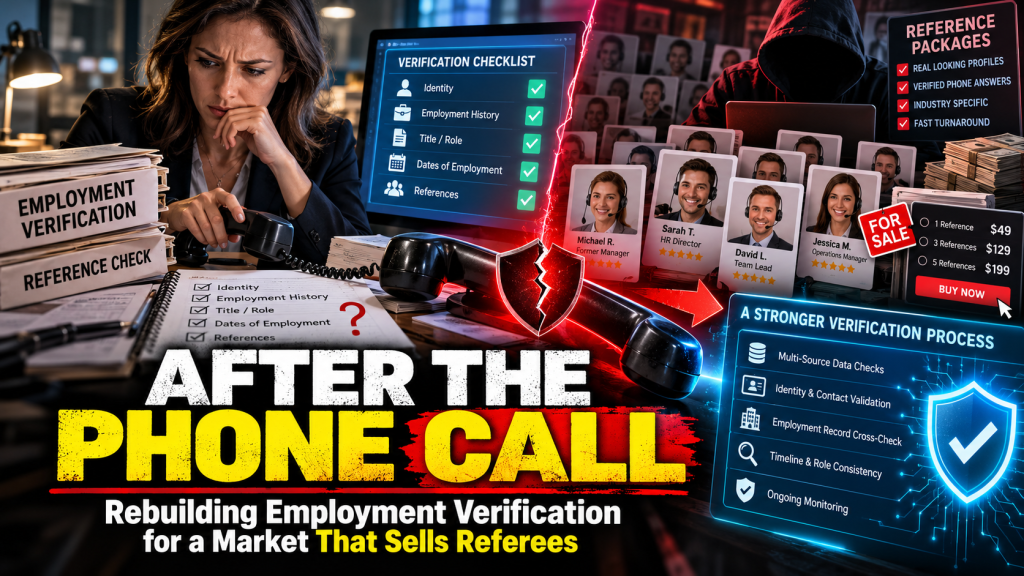
The Modernising Employment APPG’s minutes describe the model plainly. A reference house pretends to be a genuine business and offers a false reference for a work seeker. To the employer, it looks like a real company. It has a name, a website, a phone number that answers in the company’s name, an email domain that matches, and a person who will confirm the candidate’s job title, dates and conduct.
The candidate supplies the CV. The reference house supplies the employer that CV describes.
Pricing, where it has been reported, is modest relative to the salary at stake. Cifas has described packages at less than a month’s salary. Some operators bundle a crash course in the subject matter so the candidate can survive a technical interview. Some sell education references and bank references alongside employment ones. The APPG minutes list employment, education, bank and identity references as the standard menu.
This is not a cottage industry run by one person with a burner phone. It is a service business with a product, a price list, and repeat customers.
Who uses them, and why
The Cifas workplace survey is the best data on the demand side. In a representative sample of UK workers, 19% said they or someone they know had used a reference house to cover an employment gap. Thirty percent considered it justifiable.
The reasons are familiar. A gap that looks bad. A dismissal the candidate would rather not explain. A period of self-employment that produced no payslips. A qualification that was never finished. In each case the candidate is not necessarily a fraudster in any broader sense. They are a person who has decided that the reference stage is a formality worth gaming.
The problem is who else uses them. The APPG minutes include a case study that should be read by every HR leader. A jobseeker buys a false reference and career history, is hired into a role with access to customer data, and is then contacted by the reference house. Hand over the data, or the employer is told the reference was fake.
Rosser’s testimony made the same point: reference houses help people hide their past, and they also support modern slavery and create opportunities for blackmail, personal or industrial. Hiring fraud, in the UK’s framing, is linked to organised crime.
Once a candidate has used a reference house, the operator holds leverage over an employee inside the target organisation. That is the business model’s second revenue stream.
The US data
The UK has the clearest vocabulary for this, but the pattern is not British.
Greenhouse’s 2026 AI in Hiring Report, covered in FM Magazine, found that 86% of recruiters had caught or suspected candidate fraud in the previous twelve months. Asked what they had observed, the most common answer was fake references, at 51%, ahead of CV exaggeration at 35% and candidates using AI during interviews at 32%.
RefAssured’s September 2026 candidate fraud report, drawn from surveys of HR, hiring managers and staffing recruiters, adds a sharper framing. Outright identity fraud, the deepfake-and-synthetic-persona threat that dominates conference agendas, was the rarest type of fraud recruiters reported encountering: 4% of HR and hiring managers, 13% of staffing recruiters. By contrast, 61% of HR and hiring managers had seen candidates claim skills they did not have, and 98% had caught some form of misrepresentation.
Didit’s analysis of traditional candidate fraud, citing survey data on fake references, found that 37.3% involved a friend or family member posing as a former manager, 35% involved a referee invented outright, and 18.5% used an online fake reference service. Put those together and the majority of fake references do not involve any real former employer at all.
The picture across both markets is consistent. The high-tech fraud is real and growing. The high-volume fraud is the reference, and it has been scaling quietly for years.
Why the reference call fails
The traditional reference call rests on an assumption that was reasonable in 1995 and is false in 2026: that reaching a person who confirms the candidate’s employment is evidence the employment happened.
A reference house breaks that assumption at every step.
The phone number on the CV is the reference house’s number. The person who answers has the candidate’s CV open. The dates match because they were written to match. The job title matches. The reason for leaving is “pursuing a new opportunity”. The tone is professional and slightly bored, exactly like a real HR coordinator confirming a routine request.
Nothing in the call is verifiable from inside the call. The caller is checking the candidate’s story against a source the candidate supplied, and the source was built to agree.
Cifas’s insider threat team has described this as the knock-on effect: the reference stage becomes the weak link that lets other frauds through. If a fake employer can be confirmed, a fake qualification is easier to pass, a gap is easier to hide, and a dismissal for misconduct disappears from the record entirely.
What makes this an Indian and Gulf problem too
The reference house vocabulary is British, but the mechanism is universal, and in some markets it is older and larger.
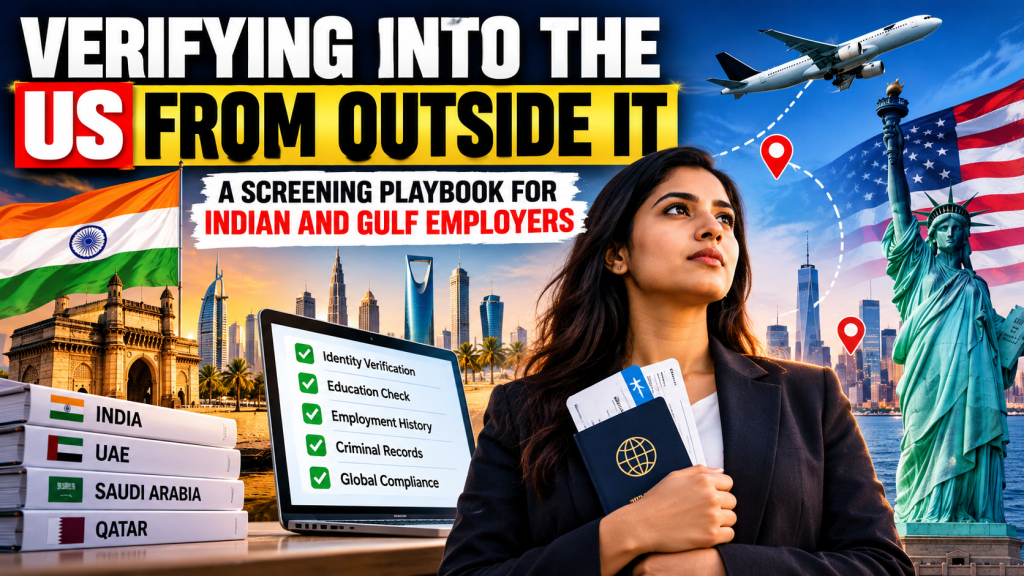
In India, the fake experience certificate industry was already well developed before the term reference house existed. Shell companies with a registered address, a letterhead, a phone line and a willingness to confirm employment have been part of the IT services hiring landscape for more than a decade. What has changed is the professionalisation: the same operation now offers the certificate, the relieving letter, the referee, and in some cases a fabricated provident fund narrative to explain why the EPFO record does not match.
In the Gulf, where a large share of the workforce is expatriate and employment history sits in a different country, the reference call is often the only check an employer can practically make on a candidate’s last three roles. A reference house operating from the candidate’s home country is almost impossible to distinguish from a genuine former employer there.
For a global verification firm, the implication is that the reference call cannot be the primary check anywhere. It has to become the last step in a chain that starts somewhere a reference house cannot reach.
What a reference house cannot fake
Every reference house has the same limitation. It can confirm what the candidate tells it to confirm. It cannot create records in systems it does not control.
In India, it cannot make the EPFO show provident fund contributions from an employer that did not make them. In the UK, it cannot alter HMRC’s PAYE record or a payroll provider’s history. In the Gulf, it cannot create a work permit or a ministry labour record. Anywhere, it cannot make a bank’s open-banking data show salary credits from a company that never paid them.
Those records are the ground truth that the reference call was always a weak proxy for. The reference house economy exists because employers kept checking the proxy and never checked the ground. The next piece is about reversing that order.
The reframe
The Better Hiring Institute’s conclusion in its 2026 guide is that hiring fraud is no longer a compliance issue but a strategic business risk, and that fraud prevention has become a core recruitment competency.
Reference houses are the clearest demonstration of why. They are cheap, they are professional, they scale, and they target the one stage of hiring that most employers have never redesigned. The reference call is the last part of the recruitment process still run the way it was run before the internet.
The industry that sells referees has noticed. Employers should too.