The natural reaction to proxy interview fraud is to train interviewers to spot it: watch for lagging audio, eyes tracking a second screen, answers that arrive a beat too polished. That instinct isn’t wrong, but it misdiagnoses the problem. Detection skills treat proxy fraud as an interviewing problem. It is an identity continuity problem.
Hiring, as most organisations run it, verifies documents at one end of the process and performance at the other. In between sit the moments that actually decide the outcome, the assessment and the interviews, and at no point does anyone confirm that the same human being is present at every stage. The application, the online test, the video rounds, the offer, and the onboarding desk are five gates, and nothing links the face at one gate to the face at the next. The proxy industry is built entirely inside that gap.
The fix, then, is not sharper suspicion. It is a chain: one verified identity, anchored early, confirmed at each gate, and reconciled at the desk. Here is how to build it, in the order that works.
Anchor Identity Before Anyone Performs
Most organisations verify identity at the point of background check, after the offer. By then, every assessment the decision rested on has already happened, performed by whoever chose to attend. The single highest-leverage change is to move identity verification to the front of the process.
Before a candidate sits an online assessment or joins a first interview, authenticate a government-issued identity document and confirm, through a live capture with liveness detection, that the person presenting it is its genuine holder. This takes minutes, is familiar to anyone who has opened a bank account, and changes the economics of the entire fraud. A proxy can perform brilliantly; what a proxy cannot do is pass a liveness-checked identity verification as someone else without committing document fraud on camera. Anchoring identity early converts an invisible substitution into a high-risk forgery, and most of the market for the service evaporates at exactly that point.
Record a Baseline, With Consent
An identity anchor is only useful if you can compare later moments against it. So record at least one interview round, with the candidate’s explicit, documented consent, and treat that recording as the reference artifact for the rest of the process.
The consent point is not a formality. Recording and biometric comparison involve personal data of the most sensitive kind, and in India that now sits under the DPDP regime’s consent and purpose-limitation requirements, with equivalents in most jurisdictions you hire from. Done properly, disclosure works in your favour twice over: it satisfies the law, and it tells every candidate, before they perform, that the process verifies attendance. Gartner’s own recommendation to employers is precisely this, to set clear expectations and make fraud detection visible, because a control that is announced deters the fraud a hidden control merely catches.
Match the Same Face at Three Points
The chain closes with comparison. Three captures, three points in time: the identity document verified at the start, the face present in the recorded interview, and a live capture at onboarding on day one. If all three are the same person, the person who was assessed is the person at the desk. If they are not, you have found the fraud before it becomes an employee.
This triangle defeats nearly every scheme in the taxonomy. The remote stand-in fails the interview-to-ID match. The full-course proxy fails the day-one match. The physical substitute at a test centre fails the ID-to-live match at check-in, which is exactly the control whose absence let impersonators sit a national space agency’s recruitment exam until a scrapped test and arrests did the job instead. What the triangle cannot fully solve alone is the synthetic overlay, the deepfaked candidate, which is why the capture points should be live and interactive rather than submitted photographs, and why the remaining sections still matter.
Design Rounds a Stand-In Cannot Survive
Process controls carry most of the load, but interview design still has a role, and it is subtler than gotcha tricks.
The shadow proxy and the coached candidate depend on transferable answers: questions whose responses can be scripted, fed, or read aloud. What breaks them is continuity and variation. Reference specifics from the candidate’s earlier rounds and their own submitted work, and ask follow-ups that build on the answer just given rather than moving to the next item on a list. Vary live problems rather than reusing a bank that circulates within hours. Keep at least one round synchronous with an experienced human interviewer, however automated the rest of the funnel becomes. And set camera and audio expectations as stated policy at the start of the process, applied to everyone, rather than improvised suspicion aimed at someone.
The goal is not to catch people in real time. It is to make the coached performance unsustainable across forty-five minutes of genuine conversation, which it reliably is.
Treat the First Month as the Final Round
The proxy economy has already told you where its weak point is. The existence of the “support buddy” product, coaching delivered through the new hire’s first weeks, is an admission that the fraud’s most fragile phase is the gap between the performance and the job.
Close that gap deliberately. Re-verify identity at onboarding as standard, the third point of the triangle. In the first thirty days, assign real work that mirrors the complexity the candidate demonstrated in assessment, reviewed by someone who saw or has access to the interview record. Treat an unexplained collapse between interview capability and desk capability as a signal worth examining, not an awkwardness to be managed quietly. The 2024 case that ended in a personation charge was exposed exactly this way, by performance, within two weeks. A structured first-month confirmation simply makes that exposure systematic instead of accidental.
High-Volume Hiring Needs Industrial Controls
Everything above scales down gracefully to a fifty-person company. Scaling it up to campus recruitment, where a single drive can involve tens of thousands of candidates, is where June’s mass deferral is instructive.
At volume, the controls have to be built into the machinery: proctored assessments whose integrity is tested rather than assumed, identity verification at test entry both online and physical, randomised in-person verification within large cohorts so no candidate can be certain of anonymity, and assessment content that rotates faster than it can circulate. And when integrity does break, the deferral itself is the right lesson: pausing twenty thousand assessments is expensive, but onboarding a cohort you cannot vouch for is more expensive. The firms that build verification into the pipeline now are buying the ability never to face that choice.
Write It Into Policy and the Offer
Controls without consequences invite testing. Put the rules in writing at three levels.
State, in the application process itself, what constitutes fraud, including impersonation, unauthorised assistance, and undeclared AI use beyond whatever you choose to permit, and state that verification is part of the process. Put personation and misrepresentation consequences into the offer letter explicitly, including the right to rescind and terminate. And adjudicate consistently when cases arise, because in India impersonation in hiring is not merely a policy breach but cheating by personation under the criminal code, and the willingness of employers to pursue it, demonstrated publicly since 2024, is part of what re-prices the fraud for everyone downstream.
Guard the Gate Without Punishing the Genuine
A final discipline, and the one that separates a mature programme from a paranoid one. Every control above can misfire on an honest person. Liveness checks fail on poor connections. Face matching underperforms across some demographics and conditions. A nervous genuine candidate can look exactly like a coached fraudulent one for the first ten minutes.
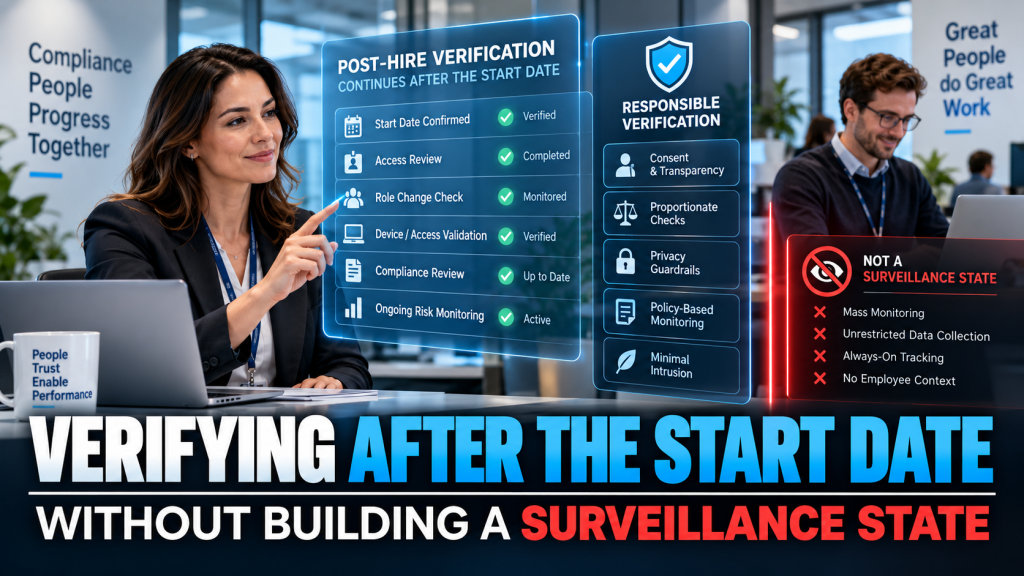
So build the programme with the honest majority as the design case. Verification steps should be quick, explained in advance, and uniform for all candidates rather than triggered by suspicion. Every automated mismatch should route to human review before any adverse step. Accommodations should exist for candidates with disabilities, poor bandwidth, or documents that don’t fit the standard mould. The measure of success is not how many frauds you catch. It is that the genuine candidate barely notices the chain at all, while the person shopping for a proxy service reads your process description and concludes the product will not work here.
The Person Is the Credential
Strip the playbook to its core and it says one thing. For twenty years, screening treated documents as the object of verification and the person as a given. The proxy economy inverted that: the documents are all genuine, and the person is the forgery.
The response is to make the person the credential. One identity, anchored before anyone performs, carried through every gate, and reconciled at the desk on day one. None of it requires exotic technology, and all of it is invisible to the candidate with nothing to hide. What it ends is the corridor the entire industry was built in: the unexamined space between the face that interviewed and the face that showed up.