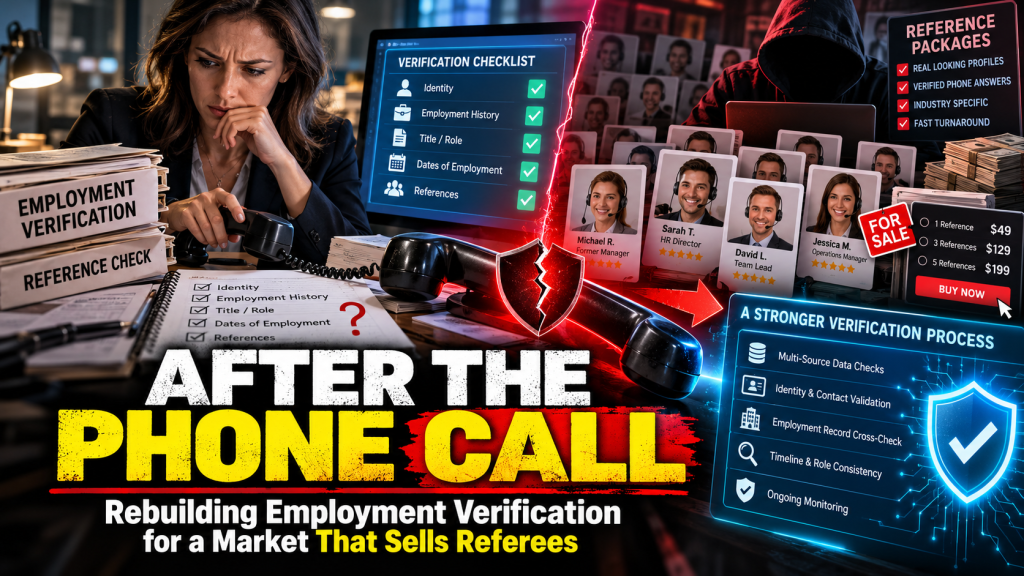
Employment verification, as most organisations practise it, spends all of its scepticism on the employee and none on the employer. The candidate’s dates are checked, their designation is checked, their documents are examined. The company those documents point to is assumed.
The fake-employer industry lives entirely inside that assumption, which means the fix begins with reversing the order of operations. Verify the entity first, then the employment. In practice this adds minutes, not days, because the strongest entity checks are free, public, and instant. What follows is the operational sequence, in the order that catches the most fraud for the least effort, along with the discipline that keeps it fair to honest candidates whose former employers genuinely no longer exist.
Run the Registry Check on Every Employer Listed
Start where the fraudster cannot follow: the government’s own records.
Every registered Indian company and LLP has a public master data record with the Ministry of Corporate Affairs, viewable free on the MCA portal without a login. It shows the company’s current status, active, struck off, dormant, or in liquidation, along with its CIN, incorporation date, registered office, directors, and the dates of its most recent filings and AGM. GST records add a second, independent layer: whether the company is registered, and whether it has been filing, which a business genuinely running a payroll invariably does.
Make this check standard for every employer on the CV, not just the most recent one. Fabricated tenures are often planted deep in the history precisely because older employers get less scrutiny. The whole pass takes a few minutes per name, and it converts “the employer exists” from an assumption into a finding.
Do the Date Arithmetic
The registry’s greatest gift is chronology, and chronology is where fake employment goes to die.
Three comparisons do most of the work. The company’s incorporation date against the candidate’s claimed start date: nobody worked somewhere before it existed. The company’s strike-off or closure date against the dates on its letters: the documented case of a relieving letter dated three years after the issuing company had been struck off the register is the canonical example, and it recurs constantly because fraudsters borrow dead companies without checking when they died. And the company’s filing activity across the claimed tenure: an “employer” of eight years with no filings for six of them is telling you something.
None of this requires judgement. It is arithmetic, performed on numbers the candidate cannot edit, and it should be the first gate every employment claim passes through.
Match the Establishment in the Statutory Record
The second authoritative layer is the provident fund system, and the key is to use it at the level of the establishment, not just the individual.
A candidate’s UAN-linked contribution history, accessed with their consent, lists each employer as a specific registered establishment. The employer on the experience letter should be the same entity making the contributions, for the same period, at a scale consistent with the claimed salary. Mismatched establishment names, contribution periods that cover half the claimed tenure, or contributions that begin suspiciously close to a job change are all findings, not curiosities.
This layer also future-proofs against the fraud’s frontier. Where operations run genuine contributions for phantom employees, individual records may look clean, but establishment-level patterns rarely do: an employer whose entire contributing workforce joined recently, contributes at minimal amounts, and has no matching tax footprint is a front wearing a payroll. The record can be gamed at the level of one employee. It is very hard to game at the level of a company.
Never Verify Through the Candidate’s Phone Number
Now the procedural rule that, on its own, defeats the entire fake-HR-desk model: no contact detail supplied by the candidate is ever used as a verification channel.
Source every employer contact independently. The registered office from the MCA record, the mainline from the company’s official domain, the HR department reached through the switchboard rather than a mobile number on a letterhead. Log the provenance of every contact used in every verification, so an audit can always answer the question “who told us this, and how did we find them?”
And retrain your instincts about responsiveness. An HR contact who replies within minutes, at any hour, with everything confirmed and nothing to check, is exhibiting the service standards of a business whose product is confirmation. Genuine HR departments are slower, because verification is a chore to them. To the fake desk, it is the job.
Inspect the Paper Like an Auditor
Documents still deserve examination, but for different tells than most reviewers look for.
Check the letterhead’s company name, character for character, against the registered name in the MCA record; near-miss names are a classic front technique. Look for the statutory identifiers a real Indian company puts on formal paper, the CIN on letters, GST details where relevant, and treat their absence as a question. Watch for template fingerprints: identical layouts, phrasing, or serial number patterns appearing across letters from supposedly unrelated employers is a strong signal that one workshop produced them all. And read salary slips against the calendar lightly here, months of salary from a company with no corresponding statutory activity, knowing that compensation documents merit a full treatment of their own, which they will get in this series shortly.
Check the Premises, Physical and Digital
Companies occupy space, physically and online, and fronts occupy as little of both as possible.
The registered office in the MCA record can be verified as a real, operating premises rather than a mailbox in a co-working suite or a residential address hosting six unrelated “consultancies.” Digital presence tells a parallel story: a company claiming a decade of operations leaves a decade of exhaust, an aged domain, archived website versions, employees findable on professional networks across the years, appearances in tenders or trade directories. A three-month-old domain under an eight-year-old employment claim is date arithmetic again, in a different register.
Protect the Honest Unverifiable
Everything above catches fraud. This section is what keeps the programme just, because the era of fake employers has a second casualty: genuine candidates whose real former employers have died.
Companies genuinely shut down, especially small ones. Employers under the provident fund threshold may never have contributed for anyone. Much of India’s MSME economy runs formally thin. So build a firm distinction into adjudication between a discrepancy, where evidence contradicts the claim, and an insufficiency, where evidence is simply absent. A struck-off company whose strike-off date falls after the candidate’s tenure is consistent with an honest history at a business that later failed. Give such candidates a structured route: the appointment letter, bank statements showing salary credits, tax documents, former colleagues willing to go on record. The test of a mature programme is not only the frauds it catches but the honest, unlucky candidates it doesn’t destroy.
Escalate on Evidence, Act on Policy
When the checks do surface fabrication, consistency matters more than fury.
Define the tiers in advance: insufficient evidence, material discrepancy, and established fabrication, each with its own consequence, from a request for further evidence through offer withdrawal to termination and reporting. Where fabrication is established, the cheating and forgery provisions of Indian criminal law apply, and sectors like IT increasingly expect reporting into shared registries so the same package cannot simply be carried to the next employer. Whatever your policy, write it down before the first case, apply it identically to the tenth, and document the evidence trail as if it will one day be read aloud in a dispute. It may be.
Make It Pipeline, Not Project
Finally, move all of this from investigation to infrastructure. Entity verification should not be a special measure triggered by suspicion; it should be a silent, standard stage that every listed employer passes through before an offer is made.
The efficient architecture mirrors what this newsletter has argued before: instant, authoritative checks first, human depth second. Registry and statutory lookups resolve most employers in minutes at negligible cost. The residue, the borderline entities, the dead companies, the establishments that don’t quite add up, goes to full business information reporting and human verification with independently sourced contacts. Write the same standard into your screening vendor’s SLA, including contact provenance, and apply extra care to documents feeding Gulf attestation pipelines, where a fake employer’s letter graduates from an HR problem into an immigration file.
A There, There
The fake-employer industry succeeds because it answers, fluently, every question the traditional process asks. The response is not to ask those questions more suspiciously. It is to ask a better first question, one the industry cannot answer, because the state’s registries answer it instead.
Does this company exist? Did it exist then? Does the government’s record of it match the paper in front of you? Five minutes per employer, spent before any phone rings, and the entire apparatus of letterheads, payslips, and helpful midnight HR desks collapses into what it always was: a story about a company, told by people who were counting on nobody checking whether there was a there, there.