The verification call goes perfectly. The HR executive picks up on the second ring, confirms the candidate’s designation, confirms the dates, offers a warm word about their professionalism, and wishes you well. The file gets stamped verified. Nothing about the call was false, in one narrow sense: a real person really did confirm the employment.
The problem is who that person works for. Not the employer on the letterhead. The fraud.
Most screening failures involve a check that wasn’t run or a detail that was missed. This category is different. Here, the check runs exactly as designed and returns exactly the wrong answer, because the thing it takes for granted, that the employer at the other end is a genuine company, is the thing being faked. Across India, a maturing industry now manufactures employers: the letterhead, the experience certificate, the salary slips, the referee, and the phone line that answers when you call. Understanding how it works has become a precondition for trusting any employment history at all.
A Company Launched to Be a Letterhead
The clearest way to understand the model is through its type specimen. In one Bengaluru case reported by Deccan Herald, police arrested a man named Satish Halyalkar who had launched a software company, I Globe Soft Labs, at his own house. The company did no software work. Its product was employment history.
Halyalkar contacted graduates who aspired to join reputed IT firms, collected Rs 25,000 to 30,000 from each, and issued experience certificates on his company’s letterhead stating that they had worked there for five years. Fake salary slips completed the package. His clients then carried those documents into some of the country’s best-known technology employers, and the scheme surfaced only when one of them joined a major IT services firm and the paperwork finally met scrutiny it couldn’t survive.
Notice what makes this elegant, from the fraudster’s side. Nothing about the documents was forged in the classic sense. The company existed on paper. The letterhead was its own. The signature was genuine. If a recruiter had called the number on the certificate, the man who answered would have been the company’s founder, director, and HR department, cheerfully confirming everything. The fraud wasn’t in the paperwork. It was one level down, in the premise.
An Industry With Customer Service
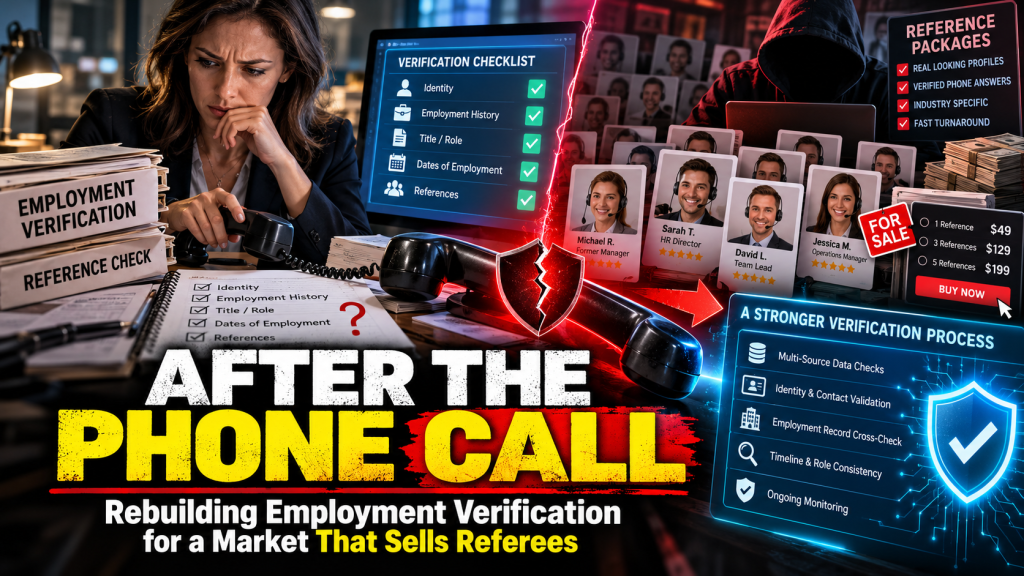
Scale that model up and you have today’s market. Recent reporting on India’s fake experience certificate economy estimates it at somewhere between Rs 500 and 1,500 crore, transacted through WhatsApp groups, Telegram channels, and a layer of dummy “HR consultancies,” with individual packages running from Rs 15,000 to as much as Rs 2 lakh depending on seniority and how much supporting apparatus is included.
And apparatus is the right word. The mature product is not a certificate but a career: the experience letter, the relieving letter, a run of salary slips, a referee’s name and number, and, at the premium end, a company with enough digital presence to survive a casual Google. The phone number on the letterhead connects to someone whose actual job is fielding verification calls, which is why the calls go so smoothly. You are not slipping past the fraud’s defences. You are talking to its front office.
The supply side is broader than dedicated criminals. Practitioners in Indian IT describe genuine small companies quietly selling experience letters as a side business, lending real letterheads to fictional tenures. That detail matters, because it means the boundary between real and fake employers is not a clean line between registered and unregistered entities. Some fake employment comes with an entirely genuine company attached.
Four Kinds of Employer That Aren’t
It helps to be precise about the variants, because they defeat different checks.
The first is pure invention: a letterhead, a mobile number, and nothing else. Crude, cheap, and still effective against employers who verify by calling whatever number the candidate provided. The second is the complicit real company, the side-business model, where the entity is genuine and the tenure is not, and where registry checks alone will find nothing wrong. The third is the borrowed corpse: a real company that has died, been struck off the register or simply wound down, whose name is attached to a fabricated tenure precisely because there is no one left to deny it. India’s successive shell-company crackdowns have removed hundreds of thousands of companies from the register since 2017, and every one of them is a name that can no longer answer the phone. The fourth is the purpose-built consultancy, the industrial version of I Globe Soft Labs: an entity created and maintained specifically to issue employment histories, with a switchboard to match.
There is a fifth variant worth naming, though it inverts the pattern: the hijacked real employer, where the company on the CV is entirely genuine and famous, and only the “HR contact” the candidate supplies is fake. Different mechanics, same lesson. The weak point is never the paper. It is the channel through which the paper gets confirmed.
Built for the Way You Verify
Here is the uncomfortable symmetry. Most employment verification in India still runs on two inputs: documents the candidate provides, and contact details the candidate provides. The fake-employer industry is a purpose-built answer to exactly those two inputs. It supplies the documents, and it supplies the person who confirms them.
Readers of this newsletter will remember the argument, made here recently, that the reference call is dying and that contemporaneous records are the better witness. The experience letter industry is what grew up in the wreckage of the reference call, and its frontier is now moving against the records themselves. Screeners and investigators have begun describing operations that go a step further and run genuine statutory contributions for phantom employees, so that even a provident fund lookup shows an employer faithfully depositing every month for a job that never existed. That frontier is still the expensive, minority case. But it signals where the arms race goes: every verification channel that becomes standard becomes a specification for the next version of the product.
The collateral damage, meanwhile, lands on honest people. When a real former employer has genuinely shut down, the candidate’s history becomes unverifiable through no fault of their own, and practitioners describe exactly this: genuine candidates under suspicion because a real past employer no longer exists to vouch for them. An era of fake employers makes dead real ones look guilty.
The Records the Fraud Cannot Author
The way through starts from a simple asymmetry. A fraudster can author anything the candidate hands you. What they cannot author is the state’s own record of the company.
Every registered Indian company has a public file with the Ministry of Corporate Affairs: its status, active, struck off, or in liquidation, its incorporation date, registered office, directors, and filing history, all viewable free on the MCA portal without a login. GST registration and filing activity add a second layer: a company genuinely paying salaries leaves a tax exhaust. And the provident fund system adds a third, because contributions are logged against a specific establishment code, so the employer in the statutory record either matches the employer on the letterhead or it does not.
One documented case shows how decisively these layers work. A senior candidate’s Rs 38 lakh offer collapsed when screening found two things: the provident fund history supported barely half the claimed experience, and the corporate registry showed the company that issued his relieving letter had been struck off the register in March 2018, three years before the letter was dated. That is the beauty of registry data. It doesn’t argue. It just does arithmetic, and a letter signed by a company that had already ceased to exist is arithmetic no phone call can rescue.
A Criminal Product With Two Victims
The legal consequences are heavier than most buyers of these packages understand. Using a fabricated experience certificate engages the classic cheating and forgery provisions of Indian criminal law, the offences long numbered 420, 467, and 471 under the IPC and now carried into the Bharatiya Nyaya Sanhita, covering cheating, forgery of valuable documents, and using a forged document as genuine. In the Rs 38 lakh case, the offer withdrawal was the beginning, not the end: a criminal complaint followed, along with entry onto shared industry blacklists that Indian IT increasingly maintains, including the NASSCOM National Skills Registry ecosystem. A Rs 50,000 shortcut can end a career across an entire sector.
Employers are the second victim, and not only through bad hires. An IT services firm that unknowingly staffs a client project with fabricated experience has a contractual honesty problem with its client, not just an HR problem. And for the large population of Indian workers heading to the Gulf, where experience documents feed visa and attestation pipelines, a fake letter stops being an employment matter and becomes an immigration one, in jurisdictions with little patience for either.
The Question Before the Question
Employment verification has always asked one question: did this person work there? The experience letter industry has made that the second question. The first is now: is there a there?
Answering it is neither difficult nor expensive, which is the strange comfort in all this. The registries exist, they are public, and the fraud cannot write to them. What has to change is the reflex: the habit of treating the employer’s existence as a given and spending all our scepticism on the employee. The industry we’ve just toured was built entirely inside that habit. The companion playbook is about breaking it, employer by employer, in about five minutes per name on the CV.