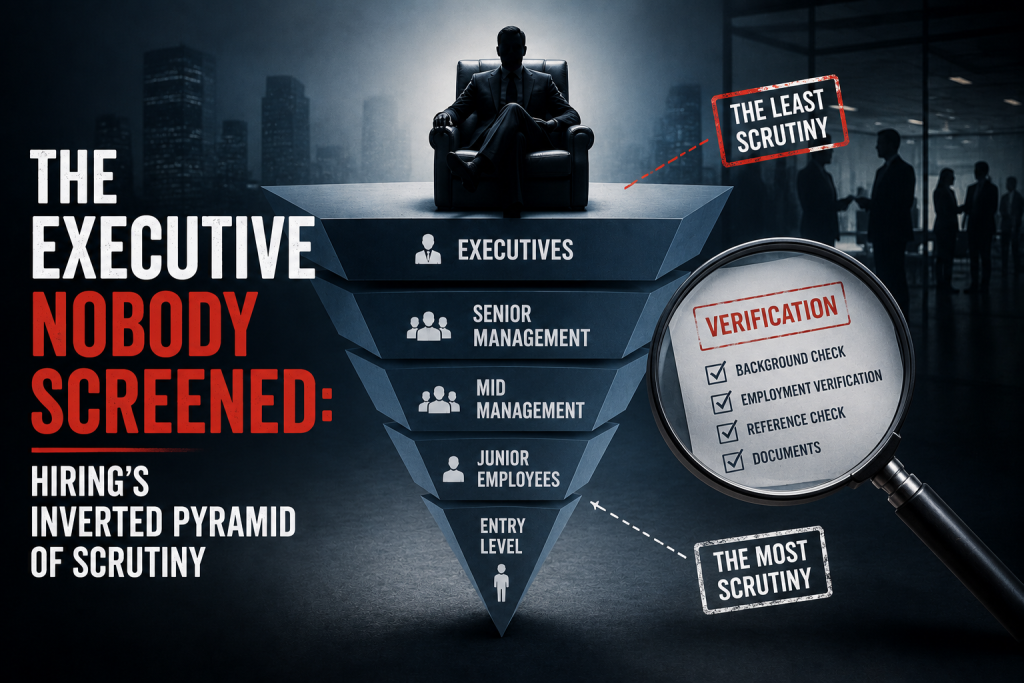
Walk the hiring process of any well-run company from the bottom up, and watch what happens to scrutiny as you climb.
The warehouse associate is screened thoroughly: identity, address, criminal record, references. The graduate engineer gets education verification, employment history, sometimes a court check. The middle manager gets all of that plus deeper employment verification. And the incoming chief executive, the person who will hold signing authority over the company’s money, access to every system, custody of its brand, and power over everyone below, gets a retained search firm’s assurance, a few dinners, and a reference call to someone who was always going to say yes.
Scrutiny, in other words, declines exactly as risk increases. It is the only place in corporate risk management where the control shrinks as the exposure grows, and it persists not because anyone decided it but because nobody ever quite decides against it. This piece is about that inversion: how it happens, what it has cost, and why the fraud economy this series has been mapping for three weeks finds its best customers at the top of the building.
How the Inversion Happens
No board votes to skip due diligence on a CEO. The inversion assembles itself from five perfectly human mechanisms.
The first is reputation-as-verification. Senior candidates arrive pre-endorsed: everyone knows her, he ran the region for a decade, the chairman has known him for years. Familiarity feels like evidence, and the better known a candidate is, the more insulting verification seems. The second is the search-firm assumption. Boards believe the retained firm “checked him out,” but executive search assesses fit, capability, and market standing. It is not forensic. Search firms interview referees the candidate nominated; they do not, as a rule, pull court records in three jurisdictions or reconcile a degree with a registrar.
The third is speed and secrecy. C-suite processes run confidentially and conclude quickly, and formal screening feels like a leak risk and a delay. The fourth is deference, the plain awkwardness of asking the future boss for marksheets. And the fifth is structural: the people who would run the check, HR and their vendors, are about to report to the person being checked. Screening flows downhill because authority flows downhill. Nobody screens up.
Each mechanism is understandable. Their sum is a standing rule that the largest risks in the organisation enter it through the smallest door.
The Case Record Is Not Kind
What does the inversion cost when it fails? The record is specific.
In 2012, Yahoo appointed Scott Thompson as chief executive. His biography claimed a computer science degree he did not hold. The claim was not merely embarrassing; it had travelled into the company’s filings with the US Securities and Exchange Commission, converting a résumé embellishment into potential disclosure liability for a listed company. The ensuing “Resumegate” cost Thompson the job within months and, more instructively, cost shareholders their confidence in the board’s own hiring practices. That is the signature of executive screening failure: the blame lands on the appointers, not just the appointed. And the fabrication had survived decades of senior roles before Yahoo, for the simple reason this series keeps encountering: a lie that is never checked compounds. Each unscreened appointment launders it for the next.
The financial cases are blunter. Bryan Sherbacow, founder and former chief executive of Alder Fuels, pleaded guilty to wire fraud in a scheme that embezzled 5.9 million dollars from his own company, and was sentenced to three years. Estimates cited by Harvard Business Review put the cost of a failed executive hire at up to three and a half times annual salary before counting the operational and cultural wreckage, and even that framing undersells the tail risk, because executive failure is not an individual’s underperformance. It is misjudgement with an organisation attached. When executives make catastrophic calls, whole institutions absorb them, as the depositors of a certain California bank discovered when its leadership’s balance-sheet decisions met rising interest rates.
The Data Behind the Discomfort
If the cases feel like outliers, the survey data says otherwise.
PwC’s long-running Global Economic Crime Survey has found roughly half of organisations reporting fraud within a two-year window, and, more pointedly, has recorded the share of internal economic crime attributed to senior management jumping from 16 to 24 percent between survey cycles. Sit with that: by the reckoning of the world’s most cited fraud survey, roughly one internal fraud in four traces to the leadership layer, the population screened least. The World Economic Forum has meanwhile noted boards being held increasingly accountable for compliance lapses, which closes the loop: the unscreened executive is becoming, formally, the board’s own liability.
The market has read the same data. This spring, the executive search industry’s trade press hosted investigators from the Mintz Group on why traditional background checks miss the reputational and behavioural risks that sink leadership appointments, and the screening industry’s largest global firms now market executive due diligence as a distinct product line, staffed by investigators rather than processors. Most telling of all is the contrast with the investment world: no serious private equity firm deploys capital without management due diligence on the founders and executives it is backing. Investors vet chief executives harder than employers do. The people writing cheques to a CEO check him more carefully than the people handing him the company.
Executive Risk Is Different in Kind
Here is the analytical core, and the reason “run the standard package, but for the CEO” misses the point. Executive risk does not live where standard screening looks.
A conventional check asks about criminal records, education, and employment dates. Executive careers generate risk in other registers entirely. Civil litigation, first: senior people sue and are sued, by former employers, partners, and shareholders, and a litigation trail across two or three jurisdictions tells you more about a leader than any criminal search. Regulatory history, second: enforcement actions, sanctions exposure, and politically exposed person status, the checks most commonly omitted from executive files. Third, and most neglected, the web of interests: directorships, shareholdings, and related parties. In India, this dimension is unusually visible, because every director carries a Director Identification Number and the corporate registry lists every board seat against it, which means an undisclosed interest in a supplier is discoverable in minutes, by anyone who thinks to look. Almost nobody looks.
Add the public record, media across the full geography and languages of a career, and the personal-conduct dimension that boards can no longer wave away, because executive scandals now travel at internet speed and take share prices with them. None of this appears in a standard package, which is why the honest conclusion is uncomfortable: most organisations that believe they screen executives are running the wrong instrument on the right person.
Where the Fraud Economy Meets the Corner Office
Now connect this series’ threads, because they all terminate here.
For three weeks, this space has mapped fraud industries engineered to pass hiring’s checks: interviews that can be bought, employers that never existed, payslips claiming salaries never paid. Ask where those products deliver the highest return, and the answer is wherever the price of the lie is highest and the probability of the check is lowest. That intersection is the senior hire. The documented case that has recurred through this series, the Rs 38 lakh offer built on fabricated tenure from a struck-off company, was not a junior candidate. Premium fraud follows premium salaries, and premium salaries are precisely where scrutiny is thinnest.
This is the seniority paradox in one sentence: the checks are strongest where the stakes are smallest. Readers may recall this series’ earlier principle for the extended workforce, that screening should follow access rather than employment labels. The executive floor is that principle’s final exam, and most organisations are failing it in the same direction: maximum access, minimum verification, on the strength of a reputation nobody ever tested.
Trust Is Not a Control
The counterargument deserves a fair hearing: leadership runs on trust, and a board that investigates its own chosen CEO signals doubt. But this confuses two different things. Trust is the relationship you build after appointment. Verification is the diligence you owe before it, to shareholders, employees, and regulators who will hold the board answerable for what it failed to check. Regulated sectors already accept this: banking regulators impose fit-and-proper requirements on directors precisely because the system learned, expensively, that eminence is not evidence.
The direction of travel is clear. Investor expectations, disclosure liability, board accountability, and a maturing executive due diligence industry are converging on the same conclusion the case record reached years ago. The handshake era is ending. What replaces it is the subject of the companion playbook: a diligence process proportionate to the office, run with the discretion the office deserves, resting on a principle simple enough for any boardroom: the more power a hire will hold, the more certainty the organisation owes itself about who is holding it.