In the second week of June, Infosys, India’s second-largest IT services company, deferred hiring assessments for more than 20,000 job applicants. Online tests were paused. In-person evaluations were paused. Candidates for the company’s Specialist Programmer and Digital Specialist Engineer trainee tracks received emails telling them their scheduled examinations would be rescheduled once new safeguards were in place. The reason, confirmed to The Times of India, was the detection of multiple instances of impersonation and assessment malpractice.
Sit with the scale of that for a moment. A company that recruits from three to four hundred colleges a year, running one of the largest campus programmes in the sector, concluded that it could not trust the integrity of its own evaluation pipeline enough to keep it running. Not for a handful of flagged candidates. For twenty thousand.
When an organisation of that sophistication pulls the emergency brake, the sensible response is not to marvel at one company’s bad month. It is to ask what changed. And what changed is this: interview impersonation has stopped being an act of individual desperation and become an industry, with suppliers, price lists, service tiers, and after-sales support. Understanding that industry is now part of understanding hiring risk.
A Service, Not a Sin of Opportunity
The mental model most hiring teams carry is of a nervous candidate making a bad decision alone: a friend on the phone, an earpiece, a whispered answer. That model is a decade out of date.
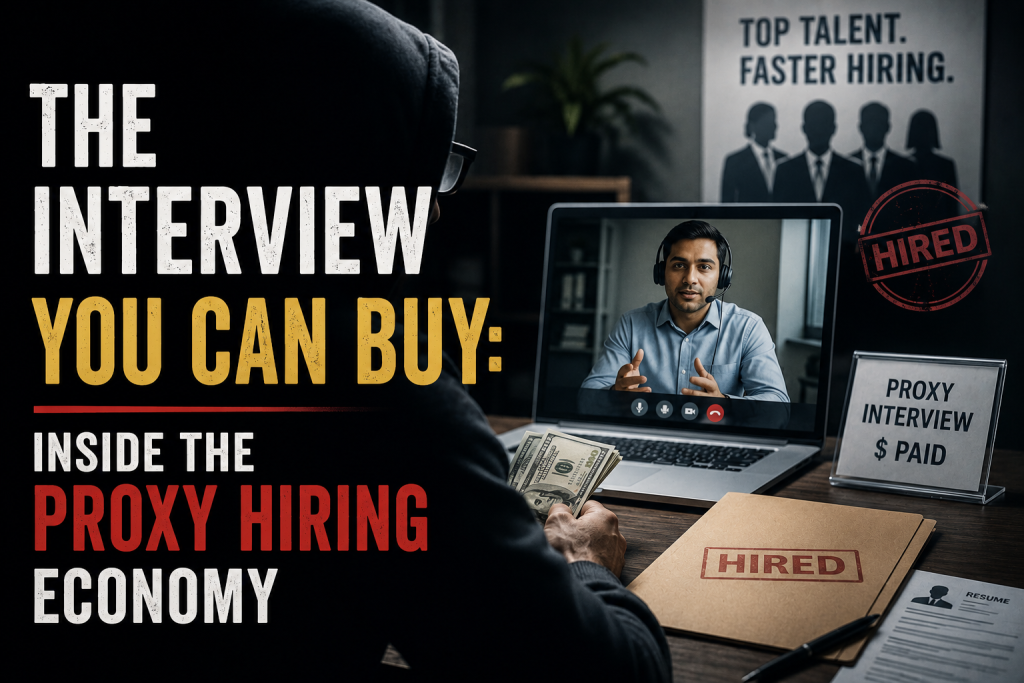
Investigations into India’s proxy interview market have documented something far more organised. Operations run openly on messaging platforms, offering a “professional interviewer” who attends video rounds in the candidate’s place, typically for between Rs 20,000 and Rs 50,000 per engagement. The commercial sophistication is the striking part. One documented operation charged Rs 35,000 with a guarantee attached: if the candidate doesn’t clear, the next attempt is free. Packages extend beyond the interview itself, bundling coaching between rounds and a “support buddy” who feeds answers over chat during the new hire’s first month on the job, smoothing over the awkward gap between the person who performed and the person who arrived.
The supply side has scaled to match. One reported ring operating out of Hyderabad serviced more than two hundred candidates in a single year. NASSCOM was flagging proxy interviews as a growing concern in Indian IT as far back as 2022. What was a favour between friends has become a market with unit economics, and markets, unlike favours, grow.
Five Ways to Not Be Yourself
It helps to be precise about what the product actually is, because it comes in several forms and they defeat different controls.
The simplest is the remote stand-in: a third party attends the video interview as the candidate, start to finish. Alongside it sits the shadow proxy, where the real candidate is on camera but a hidden partner listens in and feeds answers, sometimes by typing responses onto a second screen for the candidate to read aloud with a plausible thinking pause. In-person hiring has its own version, the physical substitute, which is anything but hypothetical: a recruitment test for technician roles at India’s space agency was scrapped outright after impersonators were caught sitting it on behalf of registered candidates, part of a racket run through a coaching centre using button cameras and wireless earpieces.
Then there is the full-course proxy, the premium product: a stand-in attends every round, and the paying customer appears for the first time at onboarding. This is the version the coaching add-ons exist to support.
The newest form dissolves the distinction between proxy and candidate entirely. With current face-swap and voice tools, a single skilled operator can present a synthetic version of the candidate’s face and voice on a live call. The FBI was warning as early as 2022 about deepfakes and stolen personal information being used to apply for remote positions, and detection firms have since reported deepfake attempts in hiring rising by more than 1,300 percent between 2023 and 2024. The proxy and the candidate can now be the same screen.
The Numbers Stopped Being Anecdotes
For years, the honest answer to “how common is this?” was a shrug and a war story. That era is over.
Gartner surveyed 3,000 job candidates in 2025 and found that 6 percent admitted to participating in interview fraud, either posing as someone else or having someone else pose as them. Think about what an admission rate of one in seventeen implies about the true rate. The same research house projects that by 2028, one in four candidate profiles worldwide will be fake, a forecast that made headlines precisely because nobody in talent acquisition found it implausible. Roughly four in ten candidates already acknowledge using AI somewhere in the application process, and Jamie Kohn, a senior research director in Gartner’s HR practice, framed the stakes in the language that should get board attention: candidate fraud creates cybersecurity risks that can be far more serious than making a bad hire.
The trajectory shows up cleanly in one company’s experience. In 2024, a widely reported case saw a man secure a role at Infosys after a friend impersonated him in the video interview; his on-the-job performance exposed him within two weeks, and he was dismissed and charged with cheating by personation. That was one man, one favour, one case. Two years later, the same company deferred assessments for twenty thousand people. The distance between those two events is the growth curve of an industry.
Why the Background Check Never Sees It
Here is the part that matters most for anyone who believes their screening programme has this covered. It almost certainly does not, and the reason is structural rather than a question of diligence.
A background check verifies the real person’s real history. It confirms that the named individual genuinely holds the degree, genuinely worked at the previous employers, genuinely has no criminal record. In a proxy scheme, all of that is true. The paying candidate is a real person with a real, verifiable past. Every document is genuine. Every check passes, because nothing in the file is false. The fraud lives somewhere the file never looks: in the substitution of one human being for another at the moment of assessment.
Gartner’s researchers put it with unusual bluntness, noting that traditional employment verifications and background checks are ill-equipped to uncover recruiting fraud because they occur at the later stages of hiring and rely on identity data the candidate supplies. Translated: hiring verifies documents at one end of the process and performance at the other, and never confirms that the same person was present at every point in between. The interview, the assessment, the offer, the onboarding desk: each is a gate, and nothing links the face at one gate to the face at the next.
That discontinuity is the product the proxy industry sells. It does not defeat your verification. It routes around it, through the one corridor where no verification was ever installed.
What It Costs When It Surfaces
The damage model is worse than a standard bad hire, and it compounds along three lines.
The first is capability and delivery. The person at the desk cannot do what the person in the interview did, which in client-facing services work means missed commitments, rework, and the quiet export of your quality problem to a customer who is paying for the opposite. The second is security. An employee who entered through deception holds legitimate credentials and access obtained on false pretences, which is why Gartner ranks the cyber dimension above the hiring dimension, and why identity fraud in recruitment increasingly lands on the desks of security teams rather than HR alone.
The third is legal and systemic. Impersonating another person to obtain advantage is cheating by personation under Indian law, an offence carried from Section 419 of the IPC into the new criminal code, and the 2024 case showed firms are willing to prosecute, not just terminate. But the widest cost falls on the honest. When integrity breaks at scale, companies respond the only way they can: assessments pause, verification tightens, timelines stretch, and twenty thousand genuine candidates wait for a rescheduled exam because a fraction of their cohort bought a service.
The Premium on Being Real
The market is already repricing. Reporting in the Wall Street Journal describes companies including Cisco and Google reinstating in-person interviews specifically to verify that candidates are who they claim to be. Across the industry, talent leaders describe a flight to quality: a deliberate step back from fully automated, fully remote pipelines toward processes where, at some point, a verified human meets a verified human.
That is not nostalgia. It is the rational response to a world where interview performance can be purchased and a clean background check can sit on top of a substituted person. The scarce commodity in hiring is no longer a polished candidate. It is certainty that the candidate and the person are the same. The organisations that can establish that certainty, efficiently and without insulting the honest majority, will hire faster than their competitors precisely because they can afford to trust their own process.
The proxy economy exists because attendance was the one thing nobody thought to verify. That oversight is now a line item in someone else’s business model. Closing it is the subject of the companion playbook, and it is considerably more achievable than the scale of the problem suggests.