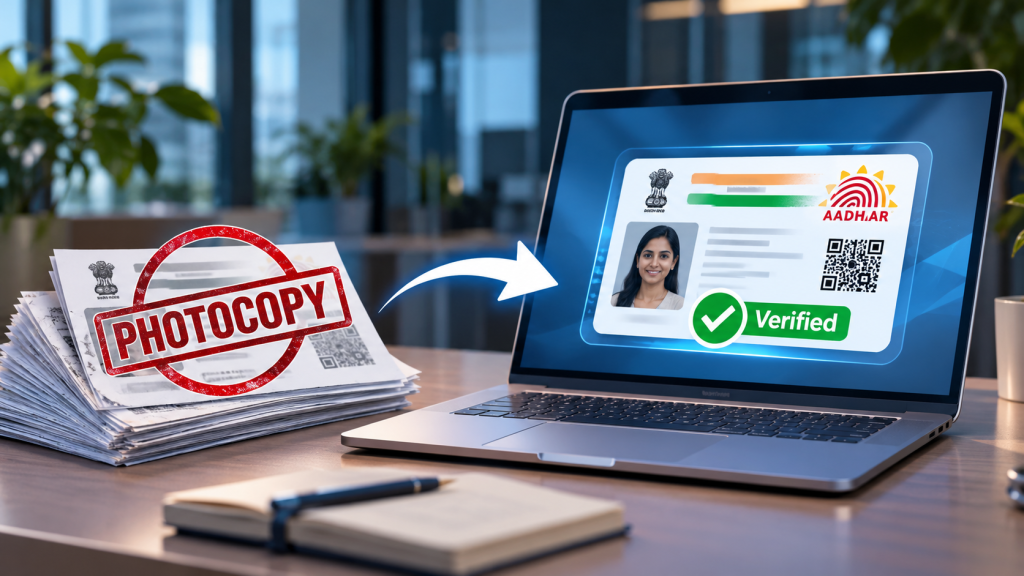
Every Indian onboarding checklist has the same line near the top. “Self-attested copy of Aadhaar card.”
The candidate photographs the card, signs across it and sends it over WhatsApp or email. HR saves it to a folder. A box is ticked, and identity is considered verified.
Nothing in that sequence checks anything. Over the past twelve months, India’s identity authority has quietly built the alternative, and the gap between the two is now too wide for employers to ignore.
Fifteen Years of Collecting, Not Checking
A photocopy answers one question: did the candidate send us an image of a card?
It does not say whether the card is genuine, whether the details were edited before the scan, or whether the person who sent it is the person on it. Anyone with a phone and a free editing app can change a name, a date of birth or a photograph.
The copy also creates a second problem. It carries a full Aadhaar number, a photograph, a date of birth and an address, and it tends to live forever. UIDAI has repeatedly warned that such copies sit unsecured in files, phones and WhatsApp chats.
So the photocopy is weak as proof and dangerous as a record. For years, that was simply how things were done.
What Changed, and When
Four developments, in order.
On 9 December 2025, UIDAI published amendments to its authentication and offline verification regulations in the Gazette. They recognise the official Aadhaar app, create a new verifiable credential that lets the holder choose which details to share, and add offline face verification.
In late January 2026, the new Aadhaar app was formally launched, with offline verification and selective sharing at its centre.
In May 2026, UIDAI invited organisations to register as Offline Verification Seeking Entities, or OVSEs, through a dedicated portal. The same month, a letter from the Secretary of MeitY asked government departments to adopt app-based offline verification, describing it as the answer to photocopy misuse.
On 9 September 2026, at the Global Fintech Fest in Mumbai, UIDAI released a Face Authentication SDK and a testing sandbox. Face authentication had first gone live in 2021. The SDK lets approved organisations run it inside their own apps.
UIDAI’s chief executive has been plain about the purpose. The objective, he said when the registration rule was approved, is to discourage paper-based Aadhaar verification.
What the Headlines Got Wrong
Most coverage ran with some version of “Aadhaar photocopies banned”. That is not quite what the regulations say, and the difference matters.
The amendment requires registration with UIDAI for any entity that wants to use paperless offline e-KYC or the new verifiable credentials through the Aadhaar app. Legal commentary on the text notes that entities verifying through a physical or electronic copy of Aadhaar, or its QR code, need not register.
So the photocopy has not been outlawed in a single stroke. Something subtler has happened. The regulator has built a better route, attached a registration regime to it and said openly that paper is what it wants to end.
The honest position for an employer is this. Collecting a copy is not, by itself, a new offence. It is a practice the regulator is steering the country away from, and one that two separate laws already make hard to defend.
Three Routes, Three Levels of Proof
It helps to separate what an employer can actually do with an Aadhaar.
The first route is the document: a physical card, an e-Aadhaar PDF or the QR code printed on either. Scanning the secure QR code confirms that the details were digitally signed by UIDAI. That is a real check, and it needs no registration. Looking at a photocopy is not the same thing.
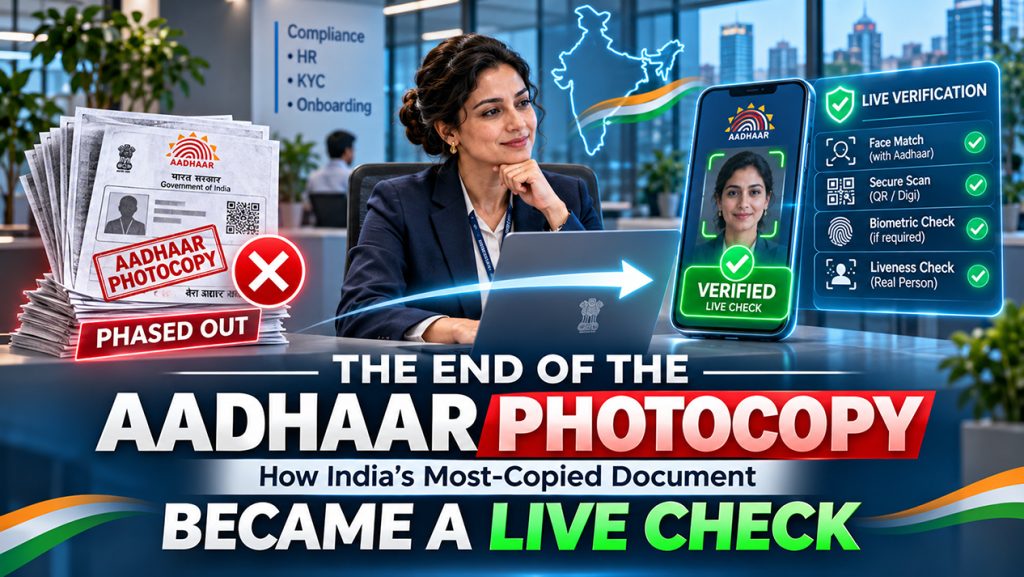
The second route is offline verification through the Aadhaar app. The candidate shares a signed credential, choosing which fields to disclose, and can add a face match to prove presence. This needs OVSE registration.
The third route is online authentication against UIDAI’s database, including face authentication. Since January 2025, private entities have been able to apply for this, but only for approved purposes, through a proposal routed via the relevant ministry. The September SDK was built for banks and fintechs. It creates no general right, and no general duty, for employers.
Most hiring will live in the first two routes. Very few employers will need the third.
Why It Matters More for Hiring Than for Hotels
The public conversation has been about hotels and event organisers. Hiring has a larger version of the same problem.
A hotel holds a guest’s copy for a night’s stay. An employer holds a copy for every candidate who ever reached the offer stage, hired or not, often across a decade.
Identity is also the foundation of the file. A court record search, an address check and an employment verification are all run against the name and date of birth on that first document. If the identity was edited, every later check has verified the wrong person very thoroughly.
High-volume hiring feels this most. In logistics, retail, security and delivery, thousands of workers are onboarded on the strength of a forwarded image, frequently by a staffing partner the employer has never audited.
Two Laws Now Pull the Same Way
The Aadhaar Act has regulated offline verification since 2019. Section 8A requires consent, limits use of the information to the purpose of verification and obliges the entity to tell the holder about alternatives. It also bars an offline verification-seeking entity from subjecting the holder to authentication. Misuse of identity information carries penalties, including imprisonment of up to three years.
The second law is newer. As we covered in October, India’s DPDP framework brings its main obligations into force on 13 May 2027, including the duty to erase personal data once its purpose is served.
Put them together. One law says to use the information only to verify. The other says to delete what is no longer needed. A folder of ten-year-old Aadhaar scans fits neither.
For Employers Outside India
Global employers often meet this through a parent-company policy. The screening standard written in London, Dubai or New York says “collect government ID” and the Indian entity complies by collecting Aadhaar copies.
That instruction now needs a second look. A copy held on a regional HR system outside India is still an Indian candidate’s Aadhaar data. The better instruction is to verify identity through a signed, consent-based route and to retain the result.
It is also worth knowing that Aadhaar is voluntary for this purpose. A sound process always offers another way to prove identity.
A Picture of a Check
The Aadhaar card has carried a signed, machine-verifiable code for years. Most of the country photographed it instead.
What changed in 2026 is that the regulator stopped tolerating the habit and built the infrastructure to replace it. The app exists. The registration route exists. The paper is what is left.
A photocopy was only ever a picture of a check. The companion playbook sets out how to run the check itself, and what to do with the pictures you already hold.