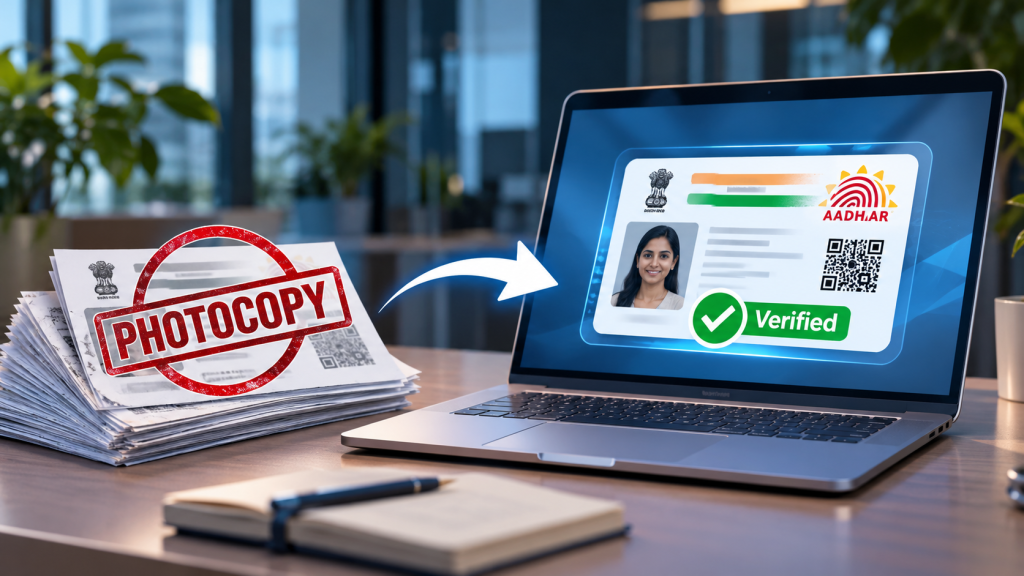
The companion piece explained how Aadhaar verification changed in 2026, and why the photocopy is now the weakest link in an Indian hiring file.
This one is for the person who has to fix it: the HR operations lead, the onboarding manager or the compliance head who owns the checklist.
The work falls into two halves. Stop creating the problem, then clean up the problem you already have.
Start by Counting What You Hold
Before changing anything, find out where Aadhaar copies live today.
The usual places are the HR system, a shared drive, recruiters’ inboxes, WhatsApp groups, the background verification vendor’s portal and staffing partners’ files. Most teams find more locations than they expected.
Count roughly how many copies exist, how old the oldest is, and how many belong to people who were never hired or who left years ago.
That number is your exposure. It is also the business case for everything that follows.
Stop New Copies at the Door
The quickest win is to remove the line “self-attested copy of Aadhaar” from every checklist, offer letter annexure and onboarding email.
Replace it with an instruction to verify, not to send. Tell candidates in advance that they will be asked to share a QR code or a credential from the Aadhaar app, and that no copy will be kept.
Train recruiters on the one habit that undoes all of this: asking for a quick photo “just for now”. The copy taken for convenience is the one that stays for ten years.
Choose the Route by Role, Not by Habit
Not every hire needs the same strength of identity proof.
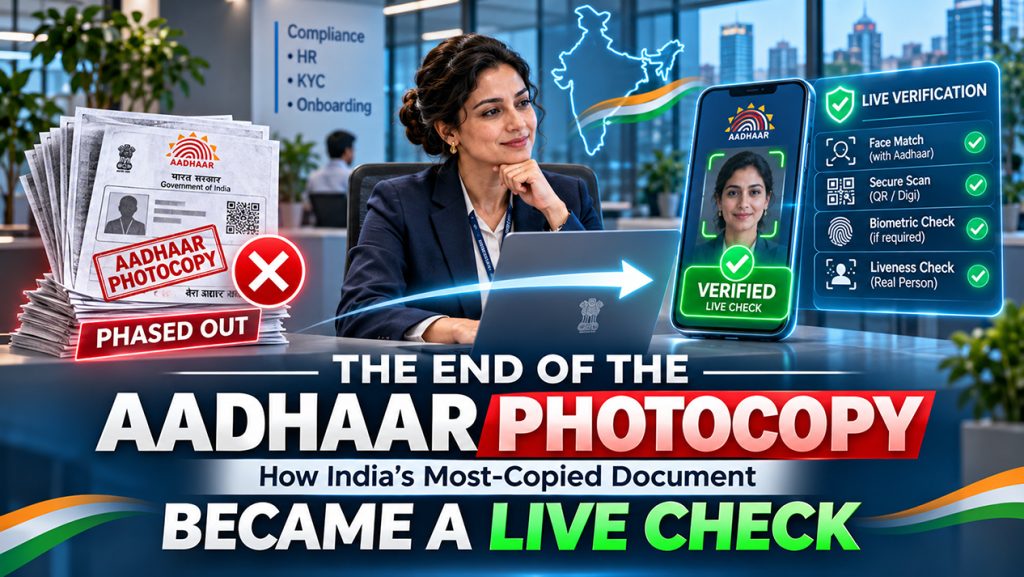
For most roles, a scan of the secure QR code on the card or e-Aadhaar is a genuine improvement. It confirms the details were signed by UIDAI, and under the current regulations it does not require registration.
For remote hires, high-volume onboarding and roles with access to money or customer data, app-based offline verification is stronger. The candidate shares only the fields you need, and a face match can show that the person presenting the credential is its holder.
Online authentication against UIDAI’s database is a different matter. It is open to private entities only for approved purposes through a formal proposal process. Do not build an onboarding flow that assumes you have it.
Write the choice into policy as tiers. A documented reason for each tier is what makes the process defensible later.
Decide Who Registers
App-based offline verification requires registration with UIDAI as an Offline Verification Seeking Entity. Any organisation can apply through UIDAI’s portal, with documents describing the business and the reason for verification.
The practical question is whether you register, your verification partner does, or both.
Take legal advice on this point before assuming your vendor’s registration covers you. The regulations contain a restriction on one entity performing offline verification on behalf of another, and the structure of your arrangement matters.
Ask every verification partner three questions. Are you registered as an OVSE? In whose name is each verification performed? What Aadhaar data do you retain afterwards, and for how long?
Rewrite the Consent Line
Offline verification under the Aadhaar Act requires the holder’s consent, and the entity must explain what information is being shared, how it will be used and what alternatives exist.
A general clause in the offer letter does not do that. Add a short, standalone notice at the point of verification. It should say which details you are requesting, that they will be used only to confirm identity, how long the result will be kept, and what other documents the candidate may use.
If you are already rebuilding your consent notices for the DPDP framework, add identity verification to the same notice. One clear notice is better than two vague ones.
Keep the Result, Not the Document
This is the change that removes most of the risk.
An audit needs to know that identity was verified, by what method, when and with what outcome. It does not need the card.
So store a verification record: the candidate’s name, the method used, the date and time, the outcome and a reference from the verification itself. Where a document reference is unavoidable, use masked Aadhaar, which shows only the last four digits.
Do not store the full Aadhaar number as an employee identifier. If your HR system has a field for it, ask why.
Always Offer Another Way
Aadhaar is voluntary for identity verification in hiring. A candidate may prefer not to use it, may not have a linked mobile number, or may be a foreign national.
Build the alternative into the process from the start. A passport, a voter ID, a driving licence or documents shared through DigiLocker can all be verified, each against its own issuing source.
Never make an offer conditional on Aadhaar specifically. The requirement is proof of identity, and the candidate chooses the document.
Clean Up the Archive
Now the second half: the copies you already hold.
Sort them into three groups. Candidates who were never hired. Former employees. Current employees.
For the first two groups, the purpose that justified collection has usually ended. Unless a specific law requires you to retain the copy, schedule it for deletion and keep only a record that identity was verified at the time.
For current employees, replace the copy with a verification record at the next natural moment, such as a role change or an annual data confirmation.
Delete from every location on your count, including inboxes and vendor portals. Ask partners to confirm deletion in writing, and log what was deleted and when. A log is evidence. A belief is not.
Carry It Through Vendors and Staffing Partners
In high-volume hiring, most identity documents are collected by someone else: a staffing agency, a field recruiter or a contractor.
Your standard has to travel with the work. Write it into contracts. No photocopies collected on your behalf. Verification by QR code or app-based credential. No Aadhaar numbers stored. Deletion on request, with confirmation.
Then test it. Ask a partner to show you how a worker placed last week was verified. The answer will tell you whether the clause is a control or a hope.
Measure the Switch
Four numbers show whether the change is real.
The share of new joiners verified by a signed route instead of a copy. The number of Aadhaar copies still held, falling month by month. The share of vendors and staffing partners confirmed as compliant. The number of identity mismatches caught at verification.
That last number is the one to watch. A process that never finds a mismatch is usually a process that is not checking.
The Check Was on the Card All Along
Nothing in this playbook requires new technology that employers must build. The signed code has been on the card for years. The app is free. The registration route is open.
What it requires is giving up a habit: the comfort of having a copy on file.
The copy never protected anyone. It did not prove the candidate was genuine, and it exposed every candidate whose details sat in the folder. Verify the person, record the result and let the paper go.