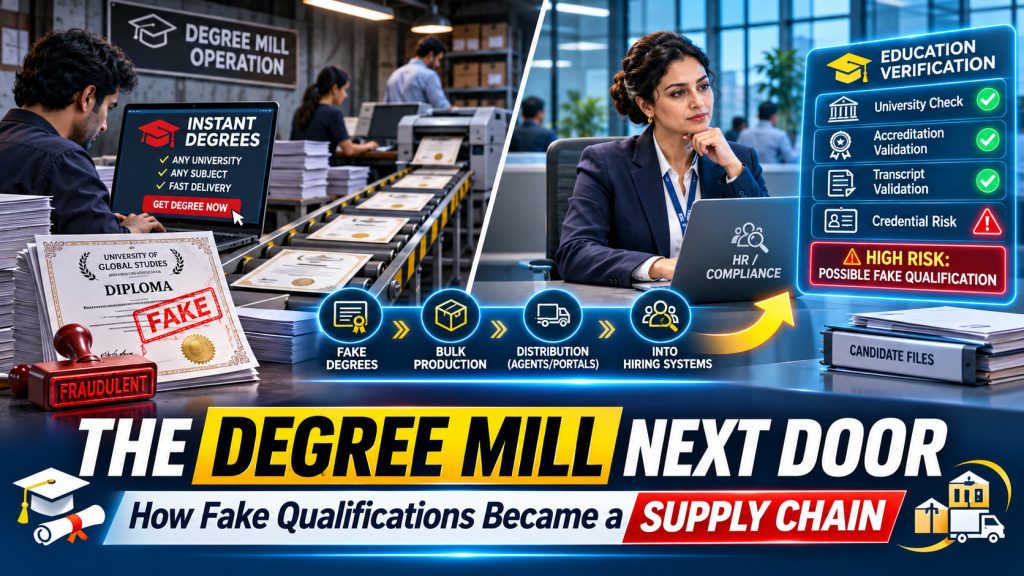
The investigation began with a courier parcel.
In late 2025, police in Ponnani, a coastal town in Kerala, intercepted a consignment of university certificates and mark lists. They followed the trail across state lines to a production centre in Tamil Nadu, and from there to the man they say ran the operation.
By the time it was over, they had seized nearly a hundred counterfeit university seals and around one lakh forged certificates carrying the names of 22 universities.
For anyone who hires, the scale is only half the story. The other half is how ordinary the business had become.
A Business, Not a Backroom
The details read like a description of a mid-sized print company.
There was a production site with advanced printing equipment. There was a distribution network that ran on courier services. There was a price list: between Rs 50,000 and Rs 1.5 lakh per certificate, depending on what the customer needed.
There was even a returning founder. The alleged leader had been arrested for producing fake certificates in 2013. He was picked up this time while trying to leave the country with his family.
Reporting on the case says the racket had supplied certificates in the names of major public and private universities since 2013, including to people seeking to study or work abroad.
Twelve years, one prior arrest, and a product good enough to pass for a decade. That is not a lapse in the system. It is a market.
Three Frauds Hiding Behind One Phrase
“Fake degree” is used for three different things, and each needs a different check.
The first is a forged certificate from a real university. The institution is genuine and recognised. The candidate simply never studied there. This is what the Kerala racket sold, and it is the hardest to spot by eye, because the template being copied is real.
The second is a real certificate from an institution that sold it. Here the paper is authentic and the university will even confirm it. The fraud is that no study took place. In the best-known Indian case, investigators found that roughly 36,000 of about 41,000 degrees issued by one private university in Himachal Pradesh were fake.
The third is a certificate from an institution that was never a university at all. The University Grants Commission keeps a public list of these. In February 2026 it named 32, with 12 in Delhi alone. The list stood at 22 the previous October, and at 20 in 2023.
An employer who checks only whether a certificate “looks right” is defenceless against all three. An employer who only asks the institution to confirm is still exposed to the second.
The People Inside the System
If fake degrees were only a problem at the margins, the education sector itself would be the last place to find them.
In July 2026, Karnataka’s Collegiate Education Department ordered criminal cases against 249 guest lecturers in government degree colleges. Verification with the universities concerned had found that the PhD certificates they submitted during the 2025-26 recruitment were fake or invalid.
Reports put the price of those PhDs at between Rs 50,000 and Rs 3 lakh, many of them from private universities outside the state.
Two things stand out. These were people hired to teach and assess students. And they were hired first, then verified. The lecturers had already been in classrooms for a year when the check caught up with them.
Why the Certificate Stopped Being Evidence
For most of the last century, a degree certificate was hard to copy. Security paper, embossing and holograms were expensive to reproduce.
That advantage has gone. Police in the Kerala case described certificates designed to closely resemble the genuine article, with authentic-looking logos, holograms and forged signatures.
The economics now favour the forger. A university prints tens of thousands of certificates a year on a public budget. A forger prints to order, for a customer paying up to Rs 1.5 lakh for a single sheet.
A senior academic in Kerala put the damage well some years ago, comparing fake certificates to counterfeit currency. One bad note makes every genuine note a little harder to trust.
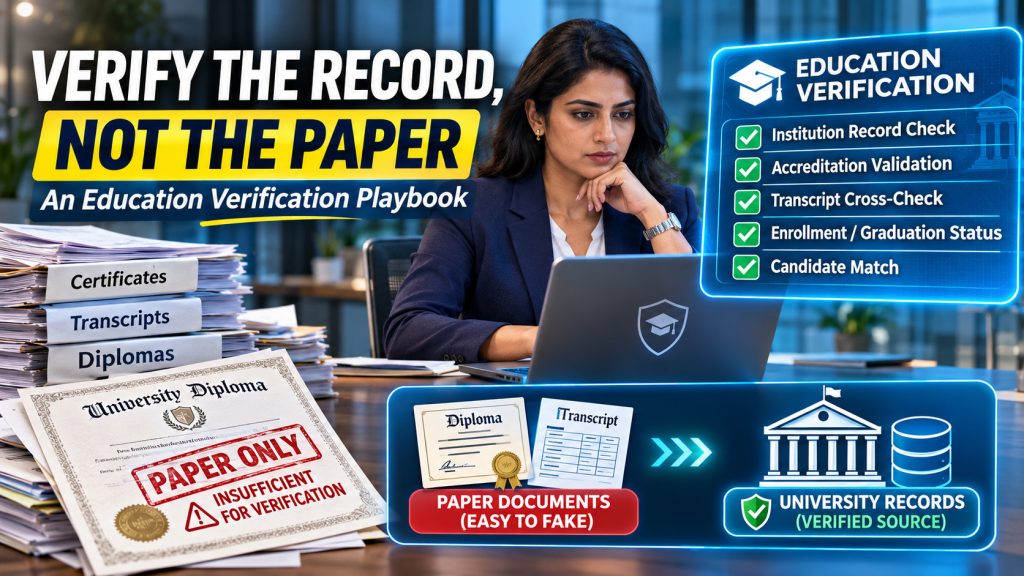
The practical conclusion is uncomfortable but simple. Inspecting the document, however carefully, is no longer verification. Only the issuing record is.
The Export Problem
India is one of the world’s largest sources of skilled professionals, so a fraud in Indian credentials does not stay in India.
The Kerala case set off a political row in Australia, a major destination for Indian students. In the United States, it put credential verification in the H-1B visa programme back in the spotlight in mid-2026.
Some of that coverage ran well ahead of the evidence, and viral claims about the share of Indian applications affected were not based on the investigation. But the direction is clear. Immigration lawyers expect closer scrutiny of foreign qualifications and heavier compliance expectations for sponsoring employers.
The earlier Himachal case showed what that looks like at ground level. Graduates working in Singapore, Malaysia, Dubai, the United States and Canada found their employers asking them to prove that their degrees were real.
The cost of this falls hardest on people who did nothing wrong. Every honest Indian graduate applying abroad now carries a little of the suspicion that the forgers created.
What India Has Built
The encouraging part of this story is that India has already built the answer.
The National Academic Depository lets institutions issue degrees, diplomas and mark sheets digitally through DigiLocker. Students hold the awards in their own account and share them with an employer by consent. The employer sees a record that came from the institution, not a scan that came from the candidate.
A government factsheet in July 2026 described the purpose plainly: physical documents are vulnerable to loss, damage and forgery, and manual verification creates delay.
It is worth being honest about the limits. Coverage depends on each institution uploading its awards, and older degrees are less likely to be there. For those, the route is still the registrar’s office. But the principle is now established in public infrastructure. A degree is a record held by its issuer, and the paper is only a receipt.
The Record, Not the Paper
The Ponnani case will not be the last. The man at its centre had been caught once before and rebuilt.
What can change is what the forgery is worth. A forged certificate has value only where someone accepts the certificate as proof. Where the employer goes to the record, the best printing in the country is wasted effort.
The companion playbook sets out how to make that the rule in your own hiring.