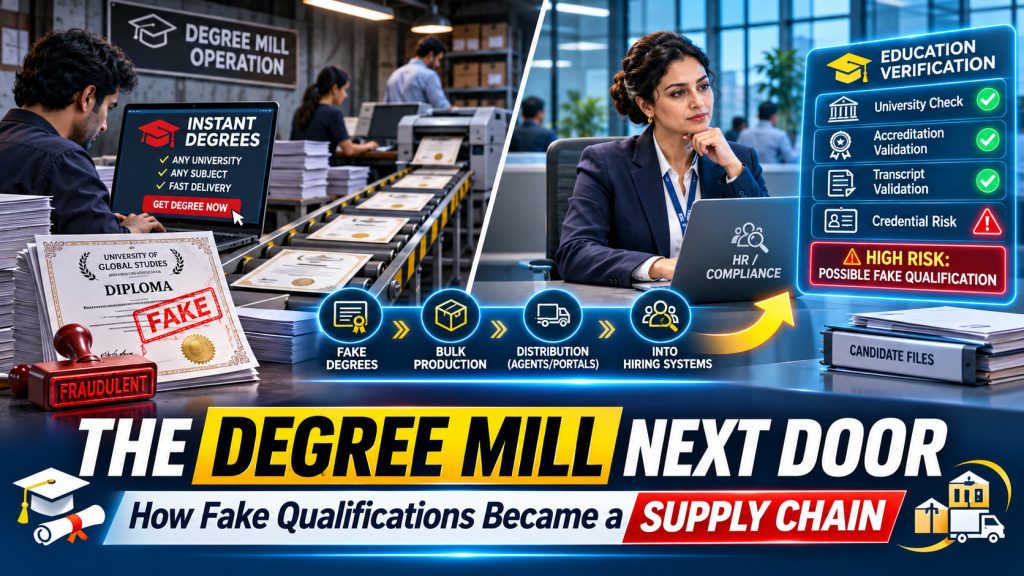
The companion piece made one argument. A degree certificate can now be forged better than the original, so looking at the certificate is no longer a check.
This playbook is about what to do instead. It is written for employers in India and for overseas employers hiring people with Indian qualifications.
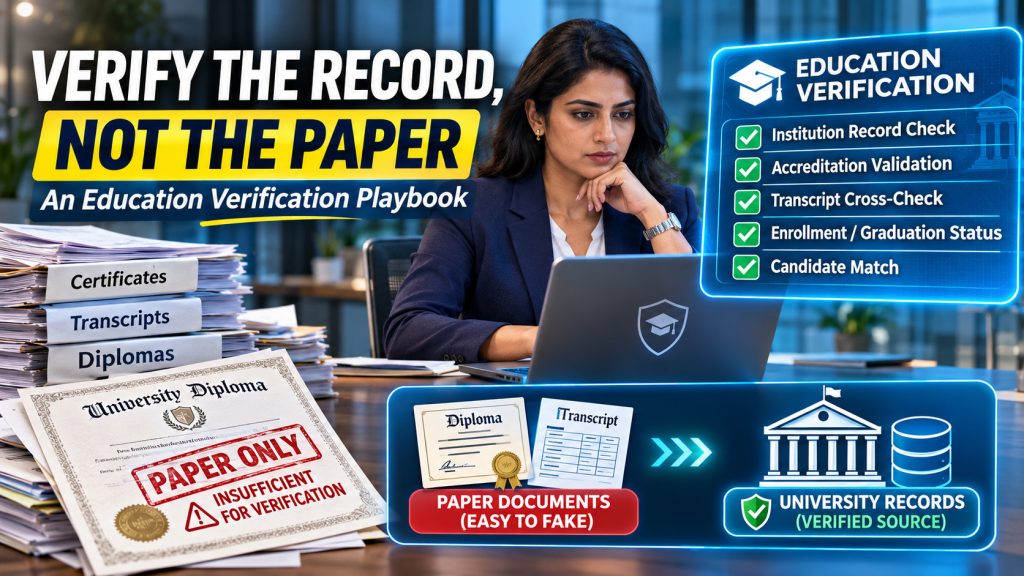
The principle runs through every step. The certificate is a claim. The record held by the issuer is the evidence.
Stop Treating the Certificate as Proof
Start with the policy wording, because that is where the habit lives.
Many hiring policies say “candidate to submit degree certificate” under the heading of verification. Change it. The candidate’s copy is the starting point for a check, and nothing more.
This matters most where no outside vendor is involved. Internal promotions, lateral transfers, contract staff and urgent hires are where a scanned certificate is most often accepted as the whole story.
Check the Institution Before the Degree
Before asking whether the candidate holds the degree, ask whether the institution could award it.
In India, that means four questions. Is the institution on the regulator’s list of recognised universities? Does it appear on the UGC’s list of fake universities? Was it recognised in the year the degree was awarded, and for that mode of study? Is the course one that needs a professional regulator’s approval?
Pay attention to mode. A university may be fully recognised for campus degrees and never approved to offer the same qualification by distance learning.
This step takes minutes, and it screens out an entire category of fraud before any letter is written.
Go to the Source by the Shortest Route
There are two reliable ways to reach the record.
The first is digital. Where the institution has issued the award through the National Academic Depository, the candidate can share it from DigiLocker with consent. The record comes from the issuer, so there is nothing for a forger to alter.
The second is direct verification with the registrar or controller of examinations. This remains necessary for many older degrees and for institutions that have not uploaded their records.
The rule that matters is how you find the institution. Use contact details from its official website or the regulator’s directory. Never use a phone number, email address or “verification portal” link supplied by the candidate or printed on the certificate. A forger who can print a hologram can also set up a helpful inbox.
Verify the Chain, Not Just the Top
For senior and specialist roles, check the qualification that made the highest one possible.
A doctorate presupposes a master’s degree. A postgraduate degree presupposes a bachelor’s. A professional licence presupposes the qualifying degree behind it.
Purchased qualifications often sit on a weak base. The MBA is fabricated, and the bachelor’s degree it would have required either does not exist or was earned years after the MBA claims to have been.
Checking one level down is cheap, and the dates alone are often revealing.
Read the Timeline
Some warning signs are visible before any verification comes back.
A full-time degree that overlaps entirely with full-time employment in another city. A qualification completed in an unusually short time. A university a long way from anywhere the candidate has lived or worked, with no distance programme to explain it. A degree that appears on the CV only after a promotion required one.
None of these proves anything. Plenty of people study part-time, and distance learning is legitimate. Each one is simply a reason to ask a question and to make sure that qualification is verified at source.
Verify Before the Start Date
Karnataka’s guest lecturers taught for a year before their certificates were checked.
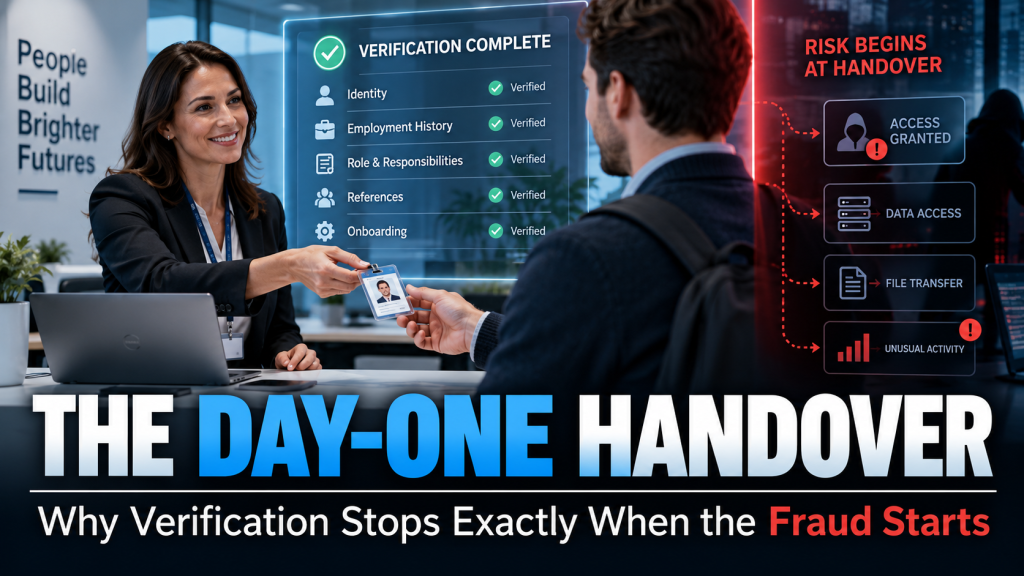
That sequence is common in private hiring too. An offer is made, a joining date is fixed, and verification runs in the background while the new hire is given a laptop and system access.
For roles where the qualification is a condition of doing the job, make verification a condition of starting it. Engineers who sign off designs, clinicians, teachers, finance professionals and anyone whose credential is shown to your clients belong in that group.
Where a start cannot wait, limit what the person can do until the check is complete, and say so in the offer.
Look Back at the Workforce You Already Have
Most organisations have employees who were hired before education checks were rigorous, or who were never checked at all.
A blanket re-verification of everyone is rarely proportionate. A risk-based audit usually is.
Start with roles where a qualification is legally or contractually required. Add roles where the degree is represented to clients or regulators. Then sample the rest.
Tell employees in advance what is being checked and why, obtain consent where the law requires it, and apply the same process to everyone in the group. A quiet check on one person who has fallen out of favour is a grievance waiting to happen.
Handle a Mismatch Fairly
A negative result is the beginning of a conversation.
Some mismatches are clerical. Names change after marriage, universities merge and rename, and records from the 1990s are sometimes simply incomplete. Ask the institution to check again with the details corrected before drawing any conclusion.
Some candidates are victims. People have paid “consultants” for what they believed was a genuine distance programme and received a worthless certificate.
Give the candidate the finding in writing and a fair chance to respond with evidence, such as fee receipts, hall tickets or mark sheets. Then decide, and record the reasoning. Where forgery is clear, take legal advice on your reporting obligations.
For Employers Outside India
Overseas employers often rely on attestation, an apostille or a credential evaluation report.
Each has a purpose, and none is verification. Attestation and apostille confirm that a seal or signature is genuine. A credential evaluation tells you what an Indian degree is equivalent to in your own system. Neither confirms that this candidate earned this degree.
Add a source check in India. It is inexpensive next to the cost of a sponsored hire, and scrutiny of foreign credentials in visa programmes is only moving in one direction.
Measure What You Find
Three numbers will tell you whether the programme is working.
The share of hires whose education was verified at source before their start date. The share of verifications completed digitally against those needing a registrar. The discrepancy rate, split by institution and by recruitment channel.
That last split is the useful one. If one recruiter or one sourcing agency produces most of your education discrepancies, you have found something more important than a single bad certificate.
The Receipt and the Record
A degree certificate is a receipt. It was issued to show that something happened elsewhere: years of study, examinations passed, a name entered in a register.
Receipts can be printed by anyone. The register cannot.
Every step in this playbook comes back to that. Check that the institution is real. Reach its record by a route the candidate does not control. Do it before the person starts. The forgers have better printers than the universities, and it makes no difference to an employer who never relied on the paper.